Sorry, you need to enable JavaScript to visit this website.
Ecole Polytechnique ENSTA Ecole des Ponts ENSAE Télécom Paris Télécom SudParis
Share

PhD Programs

The Institut Polytechnique de Paris offers a PhD training program open to the best national and international students, enabling them to work in cutting-edge research topics.

Doctoral Program Overview

As a postgraduate degree whose excellence is recognized worldwide, a PhD degree opens doors to highly skilled jobs in both the private and public sectors. Our doctoral programs are designed to develop outstanding researchers who have a deep understanding of the scientific and practical issues they study. In addition to the academic world, a PhD paves the way for major long-term careers that rely on the specific skills acquired during the doctoral training, which are widely recognized in the socio-economic world for highly qualified employment.

Doctoral research at IP Paris draws on 45 laboratories and is supported by its two doctoral schools:

The IP Paris Doctoral School (ED IP Paris),

which offers multidisciplinary doctoral training ranging from fundamental to applied research.
Discover ED IP Paris

The Hadamard Doctoral School of Mathematics (EDMH), 

which brings together all doctoral training in fundamental and applied mathematics across Institut Polytechnique de Paris and Université Paris-Saclay.
Discover EDMH

IP Paris offers two doctoral pathways:

  • Traditional 3-year PhD programs, open to Master’s graduates;
  • 5-year PhD Tracks, open to Bachelor’s graduates.

The tabs below help you quickly find what you need at every stage of your PhD journey, from application to life after your doctorate. You’ll also find useful documents and key contacts to support you along the way.

Pursuing a PhD at IP Paris means joining a world-class scientific ecosystem at the heart of one of the most dynamic academic and technology hubs in the world.

A stimulating scientific environment

Doctoral studies at IP Paris take place in an environment of excellence, working directly alongside world-class researchers. Our scientific and disciplinary diversity encourages interdisciplinary approaches and drives innovation. Research is firmly rooted in today’s major scientific and technological challenges, for the common good.

Cutting-edge technical resources

PhD students work in laboratories equipped with high-end infrastructure and equipment. Technology platforms and digital resources support ambitious, internationally competitive projects. Everything is in place to ensure optimal research conditions.

A strong international outlook and solid career prospects

IP Paris PhD students thrive in an international academic and scientific ecosystem where mobility and collaboration are encouraged. From admission to graduation, they receive personalized support from the Institute’s teams, helping them secure the best career opportunities aligned with their goals.

This support has three objectives:
- Continuously improve the quality of training;
- Strengthen PhD students’ employability;
- Expand opportunities in entrepreneurship.

Close ties with companies and innovation players increase the impact of their research and open up diverse career paths in academia, industry and the public sector, in France and abroad.

Personalized support

Every PhD student benefits from rigorous, attentive scientific supervision throughout their journey, with individualized support. This guidance comes from committed, demanding research teams on the academic side, and from the IP Paris Graduate School on the administrative side.


IP Paris Label "European Doctorate"

Institut Polytechnique de Paris awards the “European Doctorate” or “Doctor Europaeus” label. It applies to the French national doctoral degree, already recognized internationally under the Bachelor-Master-Doctorate (LMD) system, and recognizes the European dimension of the doctoral project. Learn more

Certificate of delivery of the European Doctorate label

PhD Topics at Institut Polytechnique de Paris

Admissions

There are two pathways to PhD admission at Institut Polytechnique de Paris:

Admission through a thesis project developed with a supervisor

Applicants must contact an accredited researcher (HDR) from one of IP Paris’s laboratories and work with them to develop a thesis project and a funding application. This usually takes place midway through the second year of the Master’s (M2), when students choose their research internships. Once the required documents are gathered (detailed thesis project, CV, M2 transcripts, and a letter of support from the supervisor), approval from the host laboratory and doctoral school can be obtained, and the application submitted on ADUM.

Online application for proposed PhD topics

Applicants can browse the PhD topics offered by IP Paris schools online and apply directly:


Admission Criteria

When selecting PhD students, the Doctoral Schools (EDs) consider:

  • The applicant’s previous academic results, particularly during higher education;
  • The applicant’s research aptitude, assessed in particular through research internships;
  • The fit between the applicant’s academic background and the doctoral project;
  • The originality and feasibility of the doctoral project within the context of the research unit and its partnerships;
  • The alignment of the doctoral project with the research team’s scientific strategy, confirmed by the research unit director’s approval at registration;
  • The availability and capacity of the thesis director, and more broadly of all the student’s supervisors, to provide scientific guidance for the doctoral project;
  • The applicant’s stated career plan and its consistency with the doctoral project.

The procedures for choosing and selecting PhD students are defined by the executive board and approved by the ED council.

Required Documents

Applications must include:

  • The application form;
  • CV;
  • Cover letter;
  • M1 and M2 transcripts, or equivalent foreign degrees;
  • Two letters of recommendation.

IP Paris offers two doctoral pathways: 

Traditional 3-Year PhD

IP Paris offers 3-year PhD programs across a wide range of fields. These programs are supported by 45 leading laboratories, often in partnership with CNRS and Inria. PhD students may also carry out their thesis in collaboration with a company.

5-Year PhD Track

IP Paris offers Bachelor's degree holders the PhD Track, a selective, personalized pathway that allows Master's students to gradually shape their thesis topic while immersed in cutting-edge research laboratories.
Learn more about PhD Tracks

Institut Polytechnique de Paris applies a PhD admissions policy designed to uphold the following principles in all cases:

  • Clear, public criteria and procedures, shared with host teams and prospective PhD applicants;
  • Consideration of the capacity of research units and teams to provide high-quality, personalized supervision;
  • Recruitment that promotes gender balance, diversity and openness, particularly internationally;
  • Recruitment that encourages new lines of research and takes into account PhD graduates' career and employment prospects;
  • Possible earmarking of positions.

IP Paris supports several types of funding:

  • Programs funded or coordinated by Institut Polytechnique de Paris (e.g., MESR, AMX, Hi!Paris, EUR Plasmas, E4C, E4H);
  • Funding from research organizations (e.g., ONERA, CEA, CNRS);
  • Funding from other organizations.

Doctoral Contract Competition

Institut Polytechnique de Paris runs two calls:

  • Early call;
  • Final call.

Application Review and Interview Selection Process

  • Supervisors' assessment of each application for their topic
  • Laboratory directors' assessment of each application in their laboratory
  • Pre-selection of applicants for interview, by Doctoral School scientific field, based on the application file
  • Each application will be reviewed by the jury based on the applicant's academic background (including internships), the quality of supervision, the fit between the applicant's profile and the thesis topic, and any interdisciplinary dimension, with an overall score assigned.
  • Interviews by scientific field
  • IP Paris final review committee
  • Applicant interviews

Interviews may be conducted in French or English.

The interview must include the following:

  • Briefly (~2 min): CV overview (academic background, internships, etc.)
  • Thesis topic presentation (~5-10 min): applicants must be able to clearly explain the topic as a whole, its challenges and its stakes, including any aspects outside their original discipline if the topic is interdisciplinary
  • Briefly (~2 min): motivation for the topic and career goals
  • The presentation will be followed by a Q&A session (5-10 minutes)

After the interviews, members of the disciplinary jury may update their evaluations based on applicants' performance.

Final Review Committee Composition

The final review committee will include:
(one person may represent several entities)

  • The Director of ED IP Paris
  • The Director or Deputy Director representing EDMH
  • The IP Paris Vice President for Research
  • One representative from each institution whose PhD funding is involved in the competition
  • One representative from each disciplinary jury
  • One representative from each ED IP Paris field
  • One representative from the Hi!Paris/E4C/E4H/etc. jury

2026 Timeline

Early Call

  • Deadline for submitting thesis topics on ADUM: January 15, 2026
  • Application deadline on ADUM: February 17, 2026
  • Applicant interviews: March 9-16, 2026
  • Early call results published: early April 2026

Final Call

  • Deadline for submitting thesis topics on ADUM: March 14, 2026
  • Application deadline on ADUM: April 15, 2026
  • Applicant interviews: May 12-23, 2026
  • Final call results published: early June 2026

IP Paris welcomes young researchers from France and around the world to its laboratories for their doctoral work. Whatever the discipline, IP Paris benefits from partnerships with leading national and international research institutes (CNRS, Inria, CEA, Weizmann Institute of Science, and more).

IP Paris also partners with high-tech companies and major multinational groups. Highly collaborative theses rely on the CIFRE (industrial PhD agreements) program, the many research chairs established within IP Paris schools, as well as doctoral training networks and European partnerships.

According to Law No. 2002-73, known as the Social Modernization  Act of January 17, 2002, any person, re-gardless of age, nationality, status, or level of education, who can prove at least one year of experience di-rectly related to the certification sought may apply for Validation of Acquired Experience (VAE). This certifi-cation, which may be a diploma, a title, or a professional qualification  certificate, must be registered in the National Directory of Professional Certifications (RNCP).

Further information

PhD students are admitted to one of the doctoral schools (EDs) and registered at Institut Polytechnique de Paris, which provides the institutional setting for doctoral training and awards the degree.

Registration schedule

The academic year runs from September 1 to August 31.
First-year registration must be completed between September 1 and October 31 (late registration may be accepted depending on the start date of the doctoral contract).

Tuition Fees

Fees for any academic year that has begun are due in full (no prorating), regardless of the thesis start date.
Fourth-year PhD students who defend before December 31 do not need to re-register, pay the CVEC (Student and Campus Life Contribution), or pay tuition fees.

If you have any questions about registration or re-registration, feel free to contact us. 

Presentation Thesis Monitoring Committee (anual evaluation)

As part of the monitoring of PhD students registered at IP Paris, a presentation must be held within the host team, in the presence of the two members of the individual monitoring committee, before each re-registration throughout the thesis.

Learn more

Thesis Defense Procedure

Find the full PhD thesis defense procedure here.

Useful Documents

Strongly committed to promoting doctoral mobility, IP Paris offers its PhD students the opportunity to carry out research stays of varying lengths in partner laboratories around the world. Under the Erasmus+ program, these stays cover a range of countries, including Austria, Belgium, Bulgaria, Croatia, Cyprus, the Czech Republic, Denmark, Estonia, Finland, Germany, Greece, Hungary, Iceland, Ireland, Italy, Latvia, Liechtenstein, Lithuania, Luxembourg, Malta, the Netherlands, North Macedonia, Norway, Poland, Portugal, Romania, Serbia, Slovakia, Spain, Sweden and Turkey.

(Two calls for applications: spring and fall)

Mobility allows PhD students to:

  • access resources only available abroad and collect data at a research center in another country;
  • study, develop skills and build collaborations as part of their thesis;
  • receive training in transferable skills, gain professional or non-academic experience, and develop research skills for their thesis.

Erasmus+ doctoral mobility is intended to fund mobility related to education and training. Doctoral activities focused solely on research are funded by the Horizon Europe program.

Types of Erasmus+ Doctoral Mobility

  • Long-term traineeship mobility: 2 to 12 months

For contract PhD students

  • Training mobility: 2 days to 2 months
  • Teaching mobility: 2 days to 2 months

To ensure academic recognition of activities carried out during doctoral mobility abroad, a learning agreement will be drawn up describing the activities completed on site.

Eligibility Criteria

  • Be enrolled in a doctoral program at IP Paris (IP Paris Doctoral School or Hadamard Doctoral School of Mathematics (EDMH)) within one of IP Paris's member schools (École polytechnique, ENSTA, ENPC, ENSAE Paris, Télécom Paris, Télécom SudParis) for the current academic year.

For all PhD students, with or without a doctoral contract

  • Long-term doctoral traineeship mobility (SMT): 2 to 12 months

Purpose of traineeship mobility: receive training in transferable skills, gain professional or non-academic experience, and develop research skills for the thesis.

Eligible Organizations

Any public or private organization in a program country or partner country active in the labor market or in the fields of education, training, youth, research and innovation.

Please note: mobility cannot take place in an ineligible organization, such as EU institutions or any organization funded by EU funds.

For contract PhD students only

  • Contract PhD student (staff) mobility
  • Training mobility: participation in a training, internship or job-shadowing activity at a company or higher education institution (including structured courses, blended intensive programs, language training, staff training weeks, summer schools, etc.). Duration: 2 days to 2 months, excluding travel time.
  • Teaching mobility: teaching courses integrated into the partner institution's curriculum. A teaching activity includes at least 8 hours of teaching per week. Duration: 2 days to 2 months, excluding travel time.

Additional Information

A student may take part in mobility periods totaling up to 12 months of physical mobility per study cycle, regardless of the number and type of mobility activities: during the first cycle (Bachelor's or equivalent); the second cycle (Master's or equivalent, EQF level 7); and the third cycle as a PhD student (doctoral level, EQF level 8).


Within 3 months of your defense (or 1 month for minor corrections), upload the final version of your manuscript to ADUM. Then have your library representative validate your “second submission certificate.” Once it is signed, send the certificate and your “degree issuance request” to your institution’s defense administrator.

The teaching and research departments of the Institut Polytechnique de Paris annually award department thesis Prizes, which recognize doctoral work of exceptional scientific quality and particularly innovative character. Among the department-level laureates, the Institut Polytechnique de Paris then awards the Grand thesis Prize to the most outstanding thesis in terms of scientific contribution.

CALENDAR 2026 


STEPS

DATES

First call for applications19 December 2025
Second call for applications9 January 2026
Opening of application platform9 January 2026
Application deadline15 February 2026
Candidate list sent to departments 17 February 2026
Files sent to departments 17 February 2026
Department deliberations Early April 2026
Arbitration Committee meeting  Mid-April 2026
Publication of resultsAfter the jury
Award CeremonyMay/June 2026 (graduation ceremony)

Applicants must have been enrolled as PhD students at Institut Polytechnique de Paris in one of the two doctoral schools of IP Paris (ED IP Paris or EDMH). The research work must have been carried out in a laboratory of IP Paris. The thesis defense must have taken place between January 1, 2025 and December, 31 2025 and must have led to a PhD degree. All research fields are eligible.

Consult the procedure
You must log in to your ADUM personal account to apply


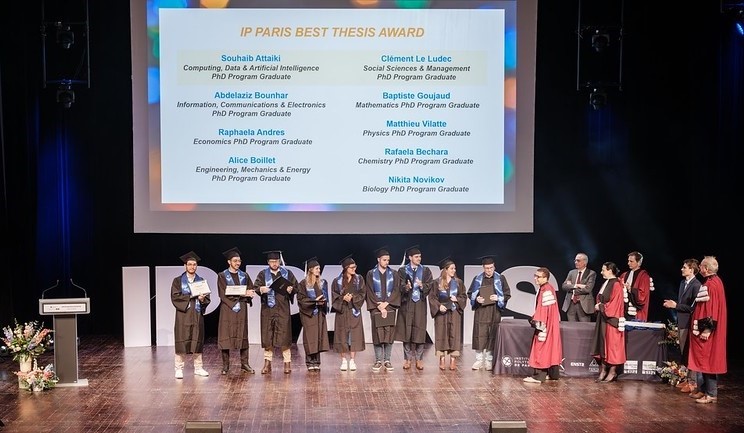
PhD thesis awards 2025 IP Paris

The Grand thesis Prize
  • Souhaib Attaiki (department Computer Science, Data, and Artificial Intelligence)
  • Le Ludec Clément (department Economics, Management, and Social Sciences)
Department thesis Prizes
  • Bounhar Abdelaziz  (department Information, communications, and electronics)
  • Andres Raphaela  (department Economics)
  • Boillet Alice  (department Mechanics, and Energetics)
  • Goujaud Baptiste  (département Mathématiques)
  • Vilatte Matthieu (department Physics)
  • Bechara Rafaela  (department Chemistry)
  • Novikov Nikita  (department Biology)


PhD thesis awards 2024 IP Paris

The Grand thesis Prize

  • Mahieu Nolwenn  (department Chemistry)

Department thesis Prizes

  • Mwamsojo Nickson  (département Information, communications, électronique)
  • Bombar Maxime  (department Computer Science, Data, and Artificial Intelligence)
  • Nimier-David Elio  (department Economics)
  • Grivet Rodolphe  (department Mechanics, and Energetics)
  • Scetbon Meyer  (department Mathematics)
  • Chakrani Jaafar (department Physics)


PhD thesis awards 2023 IP Paris

The Grand thesis Prize

  • Guerrier Sterenn (department Information, communications, and electronics)
  • Park Junha (department Physics)
     

Department thesis Prizes

  • Boyer Marin (department Mathematics)
  • Leroux Antonin (department Computer Science, Data, and Artificial Intelligence)
  • Moscatelli Marco (department Mechanics, and Energetics)
  • Toussaint Camille (département Sciences Sociales et Management)
  • Tricoire Maxime (department Chemistry)
  • Bo Zhuang (department Biology)


PhD thesis awards 2022 IP Paris

  • Boutillon Arthur (department Biology)
  • Daudel Kamélia (department Mathematics)
  • Dessalles Claire (department Mechanics, and Energetics)
  • Dong Bozhang (department Information, communications, and electronics)
  • Falmagne Guillaume (department Physics)
  • Feret Antoine (department Economics)
  • Nadjhai Kimia (department Computer Science, Data, and Artificial Intelligence)

The PhD supervision guide sets out a range of best practices for PhD students and thesis directors. These guidelines emphasize the shared responsibilities and expectations between the thesis director and the PhD student.

Other useful documents

Contact us with any questions

Your Disability Support Contacts

Each school has designated disability support contacts.
If you have any questions or need information, feel free to reach out to your school's contact.

If you're not sure who to contact, please email suivi.handicap@ip-paris.fr.

Getting Here

Institut Polytechnique de Paris - Graduate School
LE NEXT Building - 5th floor
7 Boulevard Thomas Gobert, 91120 Palaiseau, France

📍 View location on the interactive campus map

🧭 Access Guide

Pursuing a PhD at IP Paris means joining a world-class scientific ecosystem at the heart of one of the most dynamic academic and technology hubs in the world.

A stimulating scientific environment

Doctoral studies at IP Paris take place in an environment of excellence, working directly alongside world-class researchers. Our scientific and disciplinary diversity encourages interdisciplinary approaches and drives innovation. Research is firmly rooted in today’s major scientific and technological challenges, for the common good.

Cutting-edge technical resources

PhD students work in laboratories equipped with high-end infrastructure and equipment. Technology platforms and digital resources support ambitious, internationally competitive projects. Everything is in place to ensure optimal research conditions.

A strong international outlook and solid career prospects

IP Paris PhD students thrive in an international academic and scientific ecosystem where mobility and collaboration are encouraged. From admission to graduation, they receive personalized support from the Institute’s teams, helping them secure the best career opportunities aligned with their goals.

This support has three objectives:
- Continuously improve the quality of training;
- Strengthen PhD students’ employability;
- Expand opportunities in entrepreneurship.

Close ties with companies and innovation players increase the impact of their research and open up diverse career paths in academia, industry and the public sector, in France and abroad.

Personalized support

Every PhD student benefits from rigorous, attentive scientific supervision throughout their journey, with individualized support. This guidance comes from committed, demanding research teams on the academic side, and from the IP Paris Graduate School on the administrative side.


IP Paris Label "European Doctorate"

Institut Polytechnique de Paris awards the “European Doctorate” or “Doctor Europaeus” label. It applies to the French national doctoral degree, already recognized internationally under the Bachelor-Master-Doctorate (LMD) system, and recognizes the European dimension of the doctoral project. Learn more

Certificate of delivery of the European Doctorate label

PhD Topics at Institut Polytechnique de Paris

Admissions

There are two pathways to PhD admission at Institut Polytechnique de Paris:

Admission through a thesis project developed with a supervisor

Applicants must contact an accredited researcher (HDR) from one of IP Paris’s laboratories and work with them to develop a thesis project and a funding application. This usually takes place midway through the second year of the Master’s (M2), when students choose their research internships. Once the required documents are gathered (detailed thesis project, CV, M2 transcripts, and a letter of support from the supervisor), approval from the host laboratory and doctoral school can be obtained, and the application submitted on ADUM.

Online application for proposed PhD topics

Applicants can browse the PhD topics offered by IP Paris schools online and apply directly:


Admission Criteria

When selecting PhD students, the Doctoral Schools (EDs) consider:

  • The applicant’s previous academic results, particularly during higher education;
  • The applicant’s research aptitude, assessed in particular through research internships;
  • The fit between the applicant’s academic background and the doctoral project;
  • The originality and feasibility of the doctoral project within the context of the research unit and its partnerships;
  • The alignment of the doctoral project with the research team’s scientific strategy, confirmed by the research unit director’s approval at registration;
  • The availability and capacity of the thesis director, and more broadly of all the student’s supervisors, to provide scientific guidance for the doctoral project;
  • The applicant’s stated career plan and its consistency with the doctoral project.

The procedures for choosing and selecting PhD students are defined by the executive board and approved by the ED council.

Required Documents

Applications must include:

  • The application form;
  • CV;
  • Cover letter;
  • M1 and M2 transcripts, or equivalent foreign degrees;
  • Two letters of recommendation.

IP Paris offers two doctoral pathways: 

Traditional 3-Year PhD

IP Paris offers 3-year PhD programs across a wide range of fields. These programs are supported by 45 leading laboratories, often in partnership with CNRS and Inria. PhD students may also carry out their thesis in collaboration with a company.

5-Year PhD Track

IP Paris offers Bachelor's degree holders the PhD Track, a selective, personalized pathway that allows Master's students to gradually shape their thesis topic while immersed in cutting-edge research laboratories.
Learn more about PhD Tracks

Institut Polytechnique de Paris applies a PhD admissions policy designed to uphold the following principles in all cases:

  • Clear, public criteria and procedures, shared with host teams and prospective PhD applicants;
  • Consideration of the capacity of research units and teams to provide high-quality, personalized supervision;
  • Recruitment that promotes gender balance, diversity and openness, particularly internationally;
  • Recruitment that encourages new lines of research and takes into account PhD graduates' career and employment prospects;
  • Possible earmarking of positions.

IP Paris supports several types of funding:

  • Programs funded or coordinated by Institut Polytechnique de Paris (e.g., MESR, AMX, Hi!Paris, EUR Plasmas, E4C, E4H);
  • Funding from research organizations (e.g., ONERA, CEA, CNRS);
  • Funding from other organizations.

Doctoral Contract Competition

Institut Polytechnique de Paris runs two calls:

  • Early call;
  • Final call.

Application Review and Interview Selection Process

  • Supervisors' assessment of each application for their topic
  • Laboratory directors' assessment of each application in their laboratory
  • Pre-selection of applicants for interview, by Doctoral School scientific field, based on the application file
  • Each application will be reviewed by the jury based on the applicant's academic background (including internships), the quality of supervision, the fit between the applicant's profile and the thesis topic, and any interdisciplinary dimension, with an overall score assigned.
  • Interviews by scientific field
  • IP Paris final review committee
  • Applicant interviews

Interviews may be conducted in French or English.

The interview must include the following:

  • Briefly (~2 min): CV overview (academic background, internships, etc.)
  • Thesis topic presentation (~5-10 min): applicants must be able to clearly explain the topic as a whole, its challenges and its stakes, including any aspects outside their original discipline if the topic is interdisciplinary
  • Briefly (~2 min): motivation for the topic and career goals
  • The presentation will be followed by a Q&A session (5-10 minutes)

After the interviews, members of the disciplinary jury may update their evaluations based on applicants' performance.

Final Review Committee Composition

The final review committee will include:
(one person may represent several entities)

  • The Director of ED IP Paris
  • The Director or Deputy Director representing EDMH
  • The IP Paris Vice President for Research
  • One representative from each institution whose PhD funding is involved in the competition
  • One representative from each disciplinary jury
  • One representative from each ED IP Paris field
  • One representative from the Hi!Paris/E4C/E4H/etc. jury

2026 Timeline

Early Call

  • Deadline for submitting thesis topics on ADUM: January 15, 2026
  • Application deadline on ADUM: February 17, 2026
  • Applicant interviews: March 9-16, 2026
  • Early call results published: early April 2026

Final Call

  • Deadline for submitting thesis topics on ADUM: March 14, 2026
  • Application deadline on ADUM: April 15, 2026
  • Applicant interviews: May 12-23, 2026
  • Final call results published: early June 2026

IP Paris welcomes young researchers from France and around the world to its laboratories for their doctoral work. Whatever the discipline, IP Paris benefits from partnerships with leading national and international research institutes (CNRS, Inria, CEA, Weizmann Institute of Science, and more).

IP Paris also partners with high-tech companies and major multinational groups. Highly collaborative theses rely on the CIFRE (industrial PhD agreements) program, the many research chairs established within IP Paris schools, as well as doctoral training networks and European partnerships.

According to Law No. 2002-73, known as the Social Modernization  Act of January 17, 2002, any person, re-gardless of age, nationality, status, or level of education, who can prove at least one year of experience di-rectly related to the certification sought may apply for Validation of Acquired Experience (VAE). This certifi-cation, which may be a diploma, a title, or a professional qualification  certificate, must be registered in the National Directory of Professional Certifications (RNCP).

Further information

PhD students are admitted to one of the doctoral schools (EDs) and registered at Institut Polytechnique de Paris, which provides the institutional setting for doctoral training and awards the degree.

Registration schedule

The academic year runs from September 1 to August 31.
First-year registration must be completed between September 1 and October 31 (late registration may be accepted depending on the start date of the doctoral contract).

Tuition Fees

Fees for any academic year that has begun are due in full (no prorating), regardless of the thesis start date.
Fourth-year PhD students who defend before December 31 do not need to re-register, pay the CVEC (Student and Campus Life Contribution), or pay tuition fees.

If you have any questions about registration or re-registration, feel free to contact us. 

Presentation Thesis Monitoring Committee (anual evaluation)

As part of the monitoring of PhD students registered at IP Paris, a presentation must be held within the host team, in the presence of the two members of the individual monitoring committee, before each re-registration throughout the thesis.

Learn more

Thesis Defense Procedure

Find the full PhD thesis defense procedure here.

Useful Documents

Strongly committed to promoting doctoral mobility, IP Paris offers its PhD students the opportunity to carry out research stays of varying lengths in partner laboratories around the world. Under the Erasmus+ program, these stays cover a range of countries, including Austria, Belgium, Bulgaria, Croatia, Cyprus, the Czech Republic, Denmark, Estonia, Finland, Germany, Greece, Hungary, Iceland, Ireland, Italy, Latvia, Liechtenstein, Lithuania, Luxembourg, Malta, the Netherlands, North Macedonia, Norway, Poland, Portugal, Romania, Serbia, Slovakia, Spain, Sweden and Turkey.

(Two calls for applications: spring and fall)

Mobility allows PhD students to:

  • access resources only available abroad and collect data at a research center in another country;
  • study, develop skills and build collaborations as part of their thesis;
  • receive training in transferable skills, gain professional or non-academic experience, and develop research skills for their thesis.

Erasmus+ doctoral mobility is intended to fund mobility related to education and training. Doctoral activities focused solely on research are funded by the Horizon Europe program.

Types of Erasmus+ Doctoral Mobility

  • Long-term traineeship mobility: 2 to 12 months

For contract PhD students

  • Training mobility: 2 days to 2 months
  • Teaching mobility: 2 days to 2 months

To ensure academic recognition of activities carried out during doctoral mobility abroad, a learning agreement will be drawn up describing the activities completed on site.

Eligibility Criteria

  • Be enrolled in a doctoral program at IP Paris (IP Paris Doctoral School or Hadamard Doctoral School of Mathematics (EDMH)) within one of IP Paris's member schools (École polytechnique, ENSTA, ENPC, ENSAE Paris, Télécom Paris, Télécom SudParis) for the current academic year.

For all PhD students, with or without a doctoral contract

  • Long-term doctoral traineeship mobility (SMT): 2 to 12 months

Purpose of traineeship mobility: receive training in transferable skills, gain professional or non-academic experience, and develop research skills for the thesis.

Eligible Organizations

Any public or private organization in a program country or partner country active in the labor market or in the fields of education, training, youth, research and innovation.

Please note: mobility cannot take place in an ineligible organization, such as EU institutions or any organization funded by EU funds.

For contract PhD students only

  • Contract PhD student (staff) mobility
  • Training mobility: participation in a training, internship or job-shadowing activity at a company or higher education institution (including structured courses, blended intensive programs, language training, staff training weeks, summer schools, etc.). Duration: 2 days to 2 months, excluding travel time.
  • Teaching mobility: teaching courses integrated into the partner institution's curriculum. A teaching activity includes at least 8 hours of teaching per week. Duration: 2 days to 2 months, excluding travel time.

Additional Information

A student may take part in mobility periods totaling up to 12 months of physical mobility per study cycle, regardless of the number and type of mobility activities: during the first cycle (Bachelor's or equivalent); the second cycle (Master's or equivalent, EQF level 7); and the third cycle as a PhD student (doctoral level, EQF level 8).

Within 3 months of your defense (or 1 month for minor corrections), upload the final version of your manuscript to ADUM. Then have your library representative validate your “second submission certificate.” Once it is signed, send the certificate and your “degree issuance request” to your institution’s defense administrator.

The teaching and research departments of the Institut Polytechnique de Paris annually award department thesis Prizes, which recognize doctoral work of exceptional scientific quality and particularly innovative character. Among the department-level laureates, the Institut Polytechnique de Paris then awards the Grand thesis Prize to the most outstanding thesis in terms of scientific contribution.

CALENDAR 2026 


STEPS

DATES

First call for applications19 December 2025
Second call for applications9 January 2026
Opening of application platform9 January 2026
Application deadline15 February 2026
Candidate list sent to departments 17 February 2026
Files sent to departments 17 February 2026
Department deliberations Early April 2026
Arbitration Committee meeting  Mid-April 2026
Publication of resultsAfter the jury
Award CeremonyMay/June 2026 (graduation ceremony)

Applicants must have been enrolled as PhD students at Institut Polytechnique de Paris in one of the two doctoral schools of IP Paris (ED IP Paris or EDMH). The research work must have been carried out in a laboratory of IP Paris. The thesis defense must have taken place between January 1, 2025 and December, 31 2025 and must have led to a PhD degree. All research fields are eligible.

Consult the procedure
You must log in to your ADUM personal account to apply


PhD thesis awards 2025 IP Paris

The Grand thesis Prize
  • Souhaib Attaiki (department Computer Science, Data, and Artificial Intelligence)
  • Le Ludec Clément (department Economics, Management, and Social Sciences)
Department thesis Prizes
  • Bounhar Abdelaziz  (department Information, communications, and electronics)
  • Andres Raphaela  (department Economics)
  • Boillet Alice  (department Mechanics, and Energetics)
  • Goujaud Baptiste  (département Mathématiques)
  • Vilatte Matthieu (department Physics)
  • Bechara Rafaela  (department Chemistry)
  • Novikov Nikita  (department Biology)


PhD thesis awards 2024 IP Paris

The Grand thesis Prize

  • Mahieu Nolwenn  (department Chemistry)

Department thesis Prizes

  • Mwamsojo Nickson  (département Information, communications, électronique)
  • Bombar Maxime  (department Computer Science, Data, and Artificial Intelligence)
  • Nimier-David Elio  (department Economics)
  • Grivet Rodolphe  (department Mechanics, and Energetics)
  • Scetbon Meyer  (department Mathematics)
  • Chakrani Jaafar (department Physics)


PhD thesis awards 2023 IP Paris

The Grand thesis Prize

  • Guerrier Sterenn (department Information, communications, and electronics)
  • Park Junha (department Physics)
     

Department thesis Prizes

  • Boyer Marin (department Mathematics)
  • Leroux Antonin (department Computer Science, Data, and Artificial Intelligence)
  • Moscatelli Marco (department Mechanics, and Energetics)
  • Toussaint Camille (département Sciences Sociales et Management)
  • Tricoire Maxime (department Chemistry)
  • Bo Zhuang (department Biology)


PhD thesis awards 2022 IP Paris

  • Boutillon Arthur (department Biology)
  • Daudel Kamélia (department Mathematics)
  • Dessalles Claire (department Mechanics, and Energetics)
  • Dong Bozhang (department Information, communications, and electronics)
  • Falmagne Guillaume (department Physics)
  • Feret Antoine (department Economics)
  • Nadjhai Kimia (department Computer Science, Data, and Artificial Intelligence)

The PhD supervision guide sets out a range of best practices for PhD students and thesis directors. These guidelines emphasize the shared responsibilities and expectations between the thesis director and the PhD student.

Other useful documents

Contact us with any questions

Your Disability Support Contacts

Each school has designated disability support contacts.
If you have any questions or need information, feel free to reach out to your school's contact.

If you're not sure who to contact, please email suivi.handicap@ip-paris.fr.

Getting Here

Institut Polytechnique de Paris - Graduate School
LE NEXT Building - 5th floor
7 Boulevard Thomas Gobert, 91120 Palaiseau, France

📍 View location on the interactive campus map

🧭 Access Guide