Europe has no shortage of scientific and technological talent. With world-class research universities, cutting-edge facilities, and dynamic innovation ecosystems, the continent has the foundations to become a global leader in deeptech. Yet these strengths remain spread across institutions, disciplines, and national borders, making it difficult to fully harness their collective potential.
How can Europe connect these capabilities, accelerate innovation, and compete more effectively on the global stage?
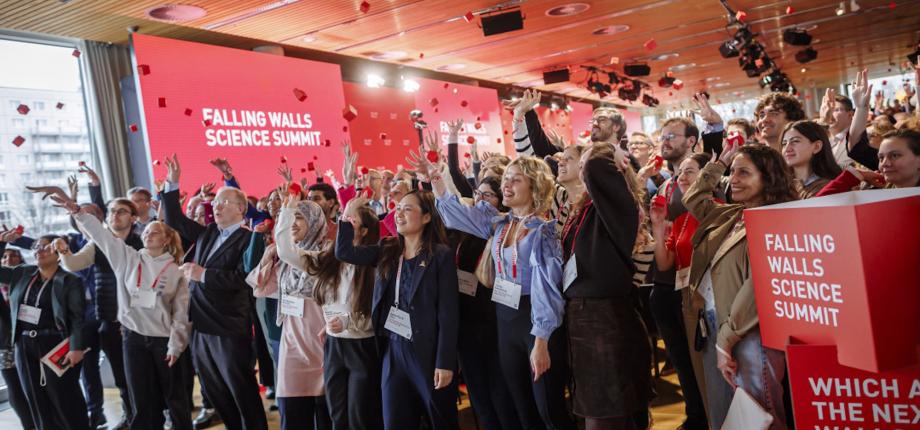
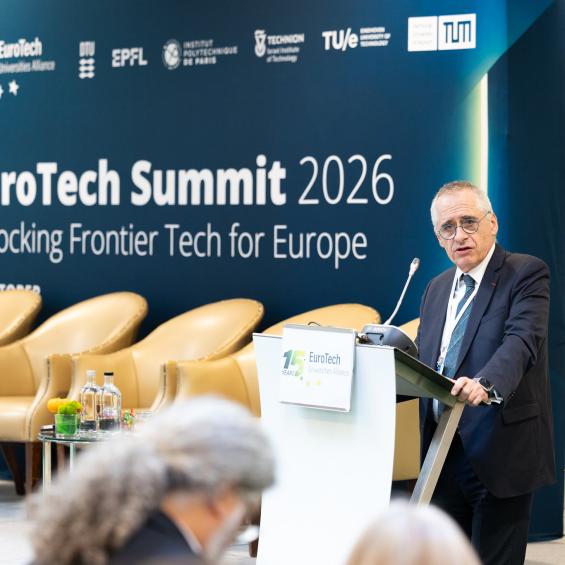
This question was at the heart of "Europe's Tech at Scale: Critical Mass for Global Leadership," a panel discussion hosted by the EuroTech Universities Alliance at Falling Walls 2026 in Berlin.
The session brought together university presidents, policymakers, and innovation leaders to explore how stronger European partnerships can unlock scientific breakthroughs, accelerate their path to market, and create lasting economic, environmental, and societal impact.
Thierry Coulhon, President of IP Paris and Chair of the EuroTech Universities Alliance for the 2026–2028 term, joined Anna Fontcuberta i Morral, President of EPFL; Christina Egelund, Denmark's Minister for Science, Higher Education and Digital Affairs; Stefan Drüssler, Chief Operating Officer of UnternehmerTUM; and Maximilian Schiffer, Co-Founder of the deep-tech startup Praedon.
Three priorities for Europe's technological future
The discussion focused on three interconnected priorities for building a stronger, more competitive European technology ecosystem.
Connecting Europe's strengths to unlock new technological frontiers. The next wave of breakthroughs, from artificial intelligence and robotics to quantum technologies, photonics, semiconductors, and advanced materials, will increasingly emerge at the intersection of scientific disciplines. By bringing together complementary expertise, research infrastructure, and innovation ecosystems, Europe can pursue opportunities that individual institutions or countries might not be able to achieve alone. Building this critical mass is essential to advancing frontier research and strengthening Europe's global competitiveness.
Rethinking the role of universities in turning research into impact. As artificial intelligence transforms scientific discovery and competition for talent intensifies, universities must rethink how they educate future generations, support entrepreneurship, and collaborate with industry. European university alliances can play a pivotal role in this transformation by expanding opportunities for students, researchers, and entrepreneurs, fostering interdisciplinary research, and strengthening connections between academia and the private sector.
Scaling innovation to compete globally. Scientific excellence alone is not enough to secure technological leadership. Europe must also create the conditions for breakthrough technologies to reach the market and for promising deep-tech startups to grow into globally competitive companies. This requires stronger connections between research institutions, investors, industry, and innovation ecosystems, as well as policies that help overcome market fragmentation. Upcoming EU research and competitiveness initiatives offer opportunities to support more ambitious cross-border partnerships and strengthen Europe's strategic technological capabilities.
EuroTech: Turning European collaboration into innovation
For Institut Polytechnique de Paris, participating in Falling Walls reflects its broader commitment to building a more connected and ambitious European research and innovation ecosystem.
Celebrating its 15th anniversary in 2026, the EuroTech Universities Alliance brings together leading European universities of science and technology to combine their strengths, advance cross-border research, and address scientific and technological challenges that extend beyond national boundaries.
Under Thierry Coulhon's chairmanship, the Alliance aims to deepen collaboration between universities, industry, and innovation ecosystems, helping Europe build the scale and capabilities needed to compete in emerging technological fields.
One example of the potential of cross-border collaboration is Praedon, a deep-tech startup co-founded by Maximilian Schiffer and Axel Parmentier, Professor at Institut Polytechnique de Paris.
Born out of research combining machine learning and mathematical optimization, including collaborations between research teams in Paris and Munich, Praedon develops AI-powered solutions to improve complex industrial decision-making.
The startup illustrates how connecting academic expertise across borders can turn scientific advances into practical solutions for industry, while creating new opportunities for research, entrepreneurship, and talent development.
About Falling Walls
Held annually in Berlin, Falling Walls is an international forum that brings together leading scientists, innovators, entrepreneurs, and policymakers to explore groundbreaking discoveries and address some of the world's most pressing challenges. Its mission is to break down barriers to scientific progress and foster new connections between research, innovation, and society.