



EuroTech Summit 2026: Five priorities for strengthening Europe's technological leadership
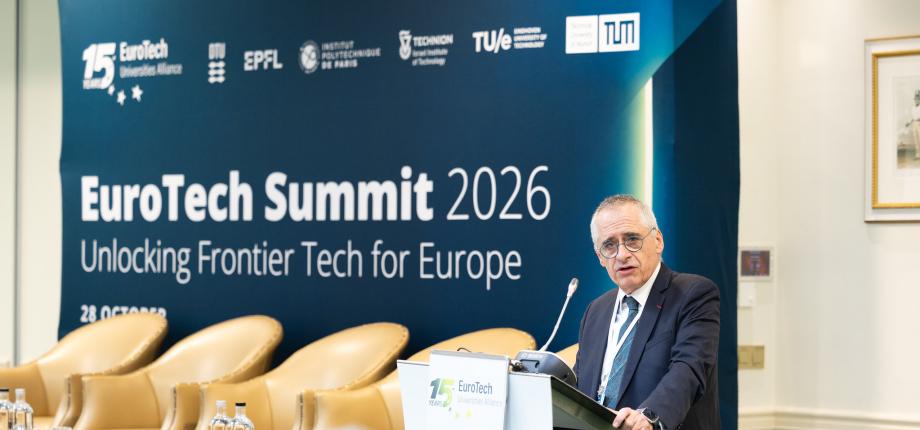
From breakthrough discoveries to industrial applications, Europe's ability to translate scientific excellence into technological leadership was at the center of the EuroTech Summit 2026, held under the theme “Unlocking Frontier Tech for Europe.”
Through discussions bringing together researchers, entrepreneurs, industry leaders, and European policymakers, the Summit highlighted the conditions needed to strengthen Europe's technological capabilities and transform its research potential into economic and societal impact.
As the European Union prepares its next research and innovation investment framework, five key priorities emerged from the discussions.
1. Invest in the breakthroughs of tomorrow
Europe's future technological leadership depends on its ability to support ambitious, long-term scientific research, including high-risk projects and discoveries whose applications are not yet fully understood.
Participants emphasized the importance of sustained investment in frontier research, particularly at the intersection of scientific disciplines, alongside the research infrastructures and technological capabilities needed to transform discoveries into strategic strengths.
The message was clear: Europe must invest not only in technologies that are already mature, but also in the scientific breakthroughs that will shape tomorrow's industries.
2. Put technology at the service of competitiveness and society
Technological innovation is essential not only to economic competitiveness but also to addressing Europe's major societal challenges.
Across discussions on digital technologies, clean energy, health, biotechnology, security, and space, speakers highlighted the contribution of technological universities to developing more sustainable industries, improving healthcare, strengthening energy security, and building greater resilience.
Beyond research and innovation, universities also play a fundamental role in educating the engineers, scientists, and entrepreneurs who will drive these transformations.
3. Connect Europe's research and innovation ecosystems
One of the Summit's central messages was the need to overcome the fragmentation of Europe's innovation landscape.
Scientific excellence alone is not sufficient. Stronger connections between universities, research organizations, industry, entrepreneurs, and public institutions are essential to accelerating innovation and maximizing its impact.
Participants emphasized that innovation is not simply a linear journey from laboratory to market. Industrial and societal challenges can also generate new research questions, creating a continuous exchange between scientific discovery and practical applications.
By connecting expertise, infrastructures, and innovation ecosystems across borders, Europe can transform its individual strengths into a collective competitive advantage.
4. Create the conditions for European deeptech to scale
Europe has a strong capacity to generate scientific breakthroughs, but bringing emerging technologies to market and developing globally competitive companies remains a major challenge.
The experiences shared by deep-tech entrepreneurs during the Summit illustrated the obstacles encountered when moving from research to industrial deployment.
Beyond financing, innovative companies need access to testing facilities, industrial partnerships, and early customers to validate their technologies and accelerate their development.
Strengthening these connections across Europe is essential to helping startups scale and ensuring that the economic and industrial benefits of European research remain anchored in Europe.
5. Strengthen the role of science in European policymaking
Scientific expertise must play a greater role in shaping Europe's strategic technological choices.
As European institutions define future research and innovation priorities, closer dialogue with the scientific community can help anticipate emerging technological opportunities, identify strategic dependencies, and assess the societal implications of new technologies.
The Summit underscored the importance of involving technological universities in these discussions, ensuring that European investment decisions are informed by scientific knowledge and long-term technological perspectives.
A new chapter for the EuroTech Universities Alliance
Beyond these strategic discussions, the Summit marked an important milestone for the EuroTech Universities Alliance, which celebrated its 15th anniversary.
Two new institutions, Czech Technical University in Prague (CTU) and Tallinn University of Technology (TalTech), signed accession agreements and will officially join the Alliance on January 1, 2027.
This expansion strengthens EuroTech's geographical reach and brings together complementary scientific expertise and innovation ecosystems.
It also reflects the ambitions of EuroTech Strategy 2030, which seeks to deepen collaboration in research and innovation, develop shared infrastructures, and reinforce the Alliance's contribution to European technological policymaking.
For Thierry Coulhon, President of Institut Polytechnique de Paris and of the EuroTech Universities Alliance, the priority is not simply to expand the network, but to strengthen its ability to act collectively and make a tangible contribution to Europe's technological future.
Celebrating Europe's next generation of researchers and innovators
The Summit also recognized emerging scientific and entrepreneurial talent through the EuroTech Rising Stars Award 2026.
The awards celebrated outstanding early-career researchers and innovators across two categories: Rising Research Starsand Rising Innovation Stars.
Yosta de Stigter (Eindhoven University of Technology) won first place in the Research category for her work on light-producing proteins for more accessible medical diagnostics.
Lukas Burgholzer (Technical University of Munich) received first place in the Innovation category for his work on software enabling better integration between quantum and conventional computing systems.
The finalists' achievements, spanning quantum technologies, photonics, renewable energy, nanotechnology, and biotechnology, illustrated the breadth of talent across the Alliance and the importance of supporting the next generation of European researchers and entrepreneurs.
Turning European ambition into collective action
The EuroTech Summit 2026 highlighted a central challenge for Europe: translating its scientific strengths into technological capabilities, industrial competitiveness, and societal progress.
Meeting this challenge will require sustained investment in frontier research, closer collaboration across innovation ecosystems, stronger support for deep-tech companies, and greater engagement between scientific communities and policymakers.
Through its Strategy 2030 and its expanding network of leading technological universities, the EuroTech Universities Alliance aims to contribute to these priorities and strengthen Europe's capacity to innovate and compete on the global stage.