



Mechanics Program
| Years | Master's Year 1 and Year 2 |
| Program | Mechanics |
| Crédits ECTS | 120 |
| Languages | English / French |
| Orientations | Research / Industry / R&D |
| Location | Palaiseau Campus |
| Course duration | 24 months, full time |
| Course start | September |
| Degree awarded | Master's degree |
WHY ENROLL IN THIS PROGRAM?
Asset n°1
Become a specialist in advanced fluid and solid mechanics, atmospheric and coastal physics, multiscale modeling, and multiphysics systems, and understand their evolution in response to environmental and technological challenges, with the opportunity to pursue a PhD.
Asset n°2
Design innovative and efficient solutions to environmental and engineering problems, assess climate and environmental risks, and optimize natural resources, advanced materials, and renewable energy systems through a research-driven approach.
Asset n°3
Benefit from a world-class learning experience through a unique alliance between Institut Polytechnique de Paris, Sorbonne Université, École Normale Supérieure, and Columbia University.
This master's program is linked to the following PhD tracks: Advanced materials, Mechanics and Bioengineering and Quantitative Life Sciences
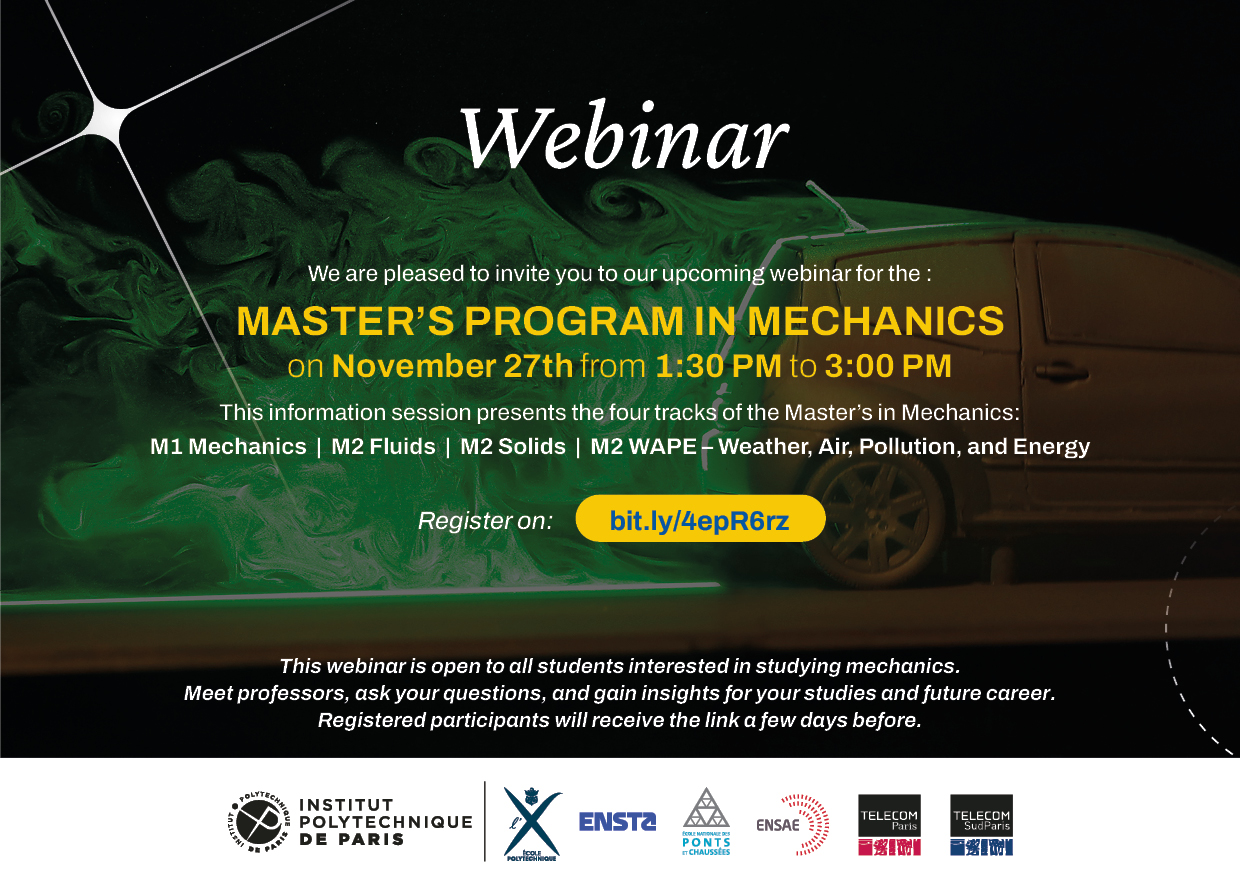
For more information about this master's program, join our next webinar:
REGISTER HERE
The Master’s program in Mechanics develops advanced expertise in structural mechanics, fluid mechanics, waves, metamaterials, environmental sciences, and renewable energy systems. It interfaces mechanics with physics, chemistry, and applied mathematics, and equips students with a strong fundamental basis for academic and industrial career paths. Courses are delivered by faculty from Institut Polytechnique de Paris (ENPC, ENSTA and École polytechnique) and Sorbonne University, ensuring strong theoretical and methodological training. The program is closely associated with six internationally recognized research laboratories of the Institut Polytechnique de Paris (IMSIA, LadHyX, LMD, LMI, LMS and Navier) for direct application into research activities and early exposure to research.
The first year offers students a high-level, research-oriented program covering a broad range of scientific fields, from fundamental to applied mechanics. It provides a strong foundation in theoretical and applied mechanics, ensuring students acquire skills in analysis, modeling, and scientific computing, as well as an initial exposure to research.
The second year offers specialization through advanced coursework and research projects, allowing students to tailor their curriculum toward materials science, acoustics, smart materials and coupled systems, or environmental sciences.
Three specialization tracks are offered, from which students must choose one.
Click on each title for more information:
The Water, Air, Pollution and Energy (WAPE) track aims to provide students with a thorough understanding of the laws and interactions governing the evolution of our natural environment at local and regional levels, thereby preparing them for successful careers in academia or industry.
Following this general framework, the WAPE track presents the dynamical, physical and biochemical processes driving oceans, atmosphere, air pollution and water cycles. The challenges of producing renewable energy are also addressed. Students will explore modern meteorological and oceanographic modelling and forecasting methods, as well as innovative observational techniques.
This program aims to enable students to:
- Critically assess the relevance and validity of different approaches to complex environmental problems;
- Determine the most appropriate parameters, develop efficient numerical algorithms and select appropriate measurement techniques relevant to specific impact studies or societal demands;
- Acquire a solid understanding of environment physics and dynamics;
- Work and communicate effectively in an English-speaking environment.
The Fluid Mechanics track offers an overall teaching experience covering the main active research domains in fluid mechanics. The first semester is dedicated to lectures in fundamental and theoretical fluid mechanics as well as numerical and experimental aspects, plus, possibly, a short research project. The second part of the year consists in an internship either in academic or industrial laboratories.
This program aims to enable students to:
- Gain expertise in fundamental and theoretical fluid mechanics covering numerical and experimental aspects during the first part of the year;
- Conduct research during an internship in an academic or industrial laboratory during the second semester.
The Solid Mechanics track is centered around the multiphysics and multiscale modeling of materials and structures, and is a program at the interface between these three fields. It provides advanced training in the fundamentals of the mechanics of materials and structures, highlighting the multiscale and multiphysics dimensions of state-of-the-art research in solid mechanics and emphasizing a mathematical approach.
In a scientific, technological, and industrial environment that increasingly requires innovative solutions, it is vital to describe the mechanical response of materials and structures in ever greater detail. This requires models that capture multiple interconnected length scales. The fast-developing research field of multiscale modeling of materials and structures is inherently multidisciplinary: physicists contribute their knowledge of how condensed matter behaves on small scales, solid mechanicians their expertise of larger scales, and applied mathematicians techniques for bridging scales.
This program aims to enable students to:
- Become experts in the development and implementation of models that efficiently predict a wide range of physical phenomena observed in structures and materials;
- Build a multidisciplinary scientific culture enabling them to interact with physicists, mechanicians, applied mathematicians, and engineers;
- Be trained in the fundamental research in solid mechanics that is likely to develop in coming decades, and discover present and potential applications in state-of-the-art technologies;
- Acquire the skills to work and communicate with ease in English-speaking environments.
Objectives
- Acquire fundamental concepts in mechanical modeling
- Master the theoretical, conceptual, and numerical tools used to solve mechanics problems
- Develop a research-oriented approach to applying knowledge
This track is well adapted for the study of the hydrospheric and atmospheric environment subject to economic or social pressure and climate change. The advanced training provided makes students specialists in the physics and dynamics of atmospheric or coastal environments and in their evolutions associated to climate change.
Graduates of this Master’s program will be equipped to apply to companies or agencies focusing on environmental problems and/or evaluating environmental or climatic risk or dealing with management and optimization of natural resources or renewable energies.
Alternatively, graduates can undertake a PhD, opening the way for a research career in academia or industry.
This track opens up a wide range of career opportunities. Most students pursue a PhD in an academic or industrial laboratory, while others directly join the research and development team of a private company.
The track in Solid Mechanics aims to train students for research in mechanics, and to a lesser degree for a career in industry. At the end of the Master’s program, students will be equipped to pursue a Ph.D. or seek employment in research and development in industry or in a public research institution.
Year 1
Core courses
| Course Title | Duration / ECTS / Language |
| Introduction to 3D Continuum Mechanics | 30h - 3 ECTS - English |
| Experimental Methods in Mechanics | 30h - 3 ECTS - English |
| Fundamentals of Fluid Mechanics | 48h - 5 ECTS - English |
| Solid Mechanics | 41h - 4 ECTS - English |
| Numerical Methods in Solid Mechanics | 30h - 3 ECTS - English |
| Introduction to Computational Fluid Dynamics | 21h - 3 ECTS - English |
| Dynamics of Solids and Structures: Waves and Vibrations | 30h - 3 ECTS - English |
| Fluid-Structure Interactions | 21h - 3 ECTS - English / French |
The scientific curriculum is completed by two optional courses to choose from among the 6 choices proposed below:
| Course title | Duration / ECTS / Language |
| Environment, Ocean and Atmosphere | 30h - 3 ECTS - French |
| Nonlinear Behaviour of Materials | 30h - 3 ECTS - English / French |
| Multiphysics Couplings | 30h - 3 ECTS - English / French |
| Acoustics in Fluid Media | 21h - 3 ECTS - English / French |
| Thermomechanics and Other Couplings in Structural Mechanics | 21h - 3 ECTS - French / English |
| Research Project Course | 30h - 3 ECTS - English |
The curriculum also includes:
- A language course (to be chosen according to the student’s level; many options are available);
- An economics course, 30 hours, 3 ECTS.
Finally, the program concludes with a research-oriented internship consisting of:
- A bibliographic study;
- A research internship in a laboratory.
Year 2
The curriculum consists in a minimum of 30 ECTS of courses chosen in the lists below and 30 ECTS corresponding to a five-month internship (in a company or a research lab) and industry opening activities. There are no compulsory courses and students have to build their individual tracks. However, the choice of the courses is subject to approval by the program directors in order to guarantee the pedagogical coherence and for specifics tracks a few courses could be chosen in another master program.
QUARTER 1
The choice of 4 to 6 courses during this period is subject to approval by the program directors.
| Course title | Duration / ECTS / Language |
| Atmospheric Dynamics and Energetics | 35h - 3 ECTS - English |
| General Circulation of the Atmosphere | 36h - 3 ECTS - English |
| Introduction to Atmospheric Composition | 42h30 - 3 ECTS - English |
| Physical Oceanography – Oceanic Circulation | 31h30 - 3 ECTS - English |
| Coastal Hydrodynamics | 36h - 3 ECTS - English |
| Sea State, Coastal Waves and Wave Energy | 40h - 3 ECTS - English |
| Continental Hydrology and Water Resource | 42h30 - 3 ECTS - English |
| Mechanics for Wind Energy, an Introduction | 42h30 - 3 ECTS - English |
| Marine Renewable Energies | 32h - 3 ECTS - English |
| Biogeochemical Cycles in the Ocean | 24h - 3 ECTS - English |
| Clouds, Aerosols and Precipitations | 31h30 - 3 ECTS - English |
| Geophysical Fluid Dynamics – Models and Their Main Properties | 36h - 3 ECTS - English |
| Meso-scale and Boundary Layer Meteorology | 31h30 - 3 ECTS - English |
| Biogeochemical Cycles and Interactions with the Biosphere at Global Scale | 26h - 3 ECTS - English |
| Atmospheric Chemistry and Air Quality: Processes and Modelling at Urban to Global Scales | 36h - 3 ECTS - English |
| Personal Research Project | 3 ECTS - English |
QUARTER 2
The choice of 4 to 6 courses during this period is subject to approval by the program directors. This list may change.
| Course title | Duration / ECTS / Language |
| Climate Change and Energy Transition | 41h15 - 3 ECTS - English |
| Hydro, Wind and Marine Resources for Renewable Energy | 41h15 - 3 ECTS - English |
| Data Analysis | 31h30 - 3 ECTS - English |
| Introduction to Data Assimilation | 31h30 - 3 ECTS - English |
| Meteorology and Environment | 41h15 - 3 ECTS - English |
| Computational Mechanics for Ocean & Atmosphere | 40h - 3 ECTS - English |
| Advanced Experimental Methods | 31h30 - 3 ECTS - English |
| Energy Economics with Geography Focus | 40h - 3 ECTS - English |
| The Economics of Energy and Sustainable Development | 40h - 3 ECTS - English |
| Physical Oceanography - Oceanic Processes | 27h - 3 ECTS - English |
| Geophysical Fluid Dynamics - Principal Dynamical Phenomena at Large and Medium Scales | 31h30 - 3 ECTS - English |
| Turbulence Dynamics | 38h15 - 3 ECTS - English |
| Instabilities and Control of Shear Flows | 32h - 3 ECTS - English |
QUARTER 3 - INTERNSHIP
A master internship having a minimal duration of five months, in a company or a research lab, is required to validate 30 ECTS. The participation to the Industry Week Energy & Environment, dedicated to opening talks or activities provided by industry or is compulsory.
STUDY ABROAD
Students may spend a semester in a partner university abroad.
SEMESTER 1
3 ECTS per lectures, 10 lectures to choose among the following list with the possibility to exchange few lectures with other lectures from the master. Written or project exams.
Find the course syllabi by clicking here.
| Course Titles | Duration / ECTS |
| Advanced Experimental Methods in Fluid Mechanics | 30h - 3 ECTS |
| Drops, Bubbles and Co | 30h - 3 ECTS |
| Fundamental of Aerodynamics | 16h - 1.5 ECTS |
| Introduction to Hydrodynamic Instabilities | 28h (+ project presentation) - 3 ECTS |
| Introduction to Numerical Simulation in Multiphase Fluid Mechanics | 30h - 3 ECTS |
| Introductory Research Project | at least 40h - 3 ECTS |
| Microhydrodynamics | 32h - 3 ECTS |
| Multiscale Hydrodynamic Phenomena | 30h - 3 ECTS |
| Optimisation Algorithms | 18h - 1.5 ECTS |
| Reduced Order Modelling and Control of Fluid Instabilities | 36h - 3 ECTS |
| Selected Topics in Geophysical and Astrophysical Fluid Dynamics | 32h - 3 ECTS |
| Turbulence | 32h - 3 ECTS |
SEMESTER 2
Internship
SEMESTER 1
- Period 1 (from September to November), the 5 required courses listed below
| Course title | Duration / ECTS / Language |
| Numerical methods for nonlinear solids and structures | 27h - 3 ECTS - English |
| Fracture Mechanics | 27h - 3 ECTS - English |
| Image-based experimental analysis of materials and structures (I-BEAMS) | 27h - 3 ECTS - English |
| Homogenization for continuous mechanics | 27h - 3 ECTS - English |
| Inelastic Behaviors of Structures | 27h - 3 ECTS - English |
- Period 2 (from December to February)
| Course title | Duration / ECTS / Language |
| Required course | |
| Artificial Intelligence for Solids and Structures | 27h - 3 ECTS - English |
| Elective courses: at least 4 to be chosen from the courses below | |
| Multiphysics problems: Phase transformations in solids | 27h - 3 ECTS - English |
| Heterogeneous materials: glasses | 27h - 3 ECTS - English |
| Soft materials | 27h - 3 ECTS - English |
| Metamaterials for wave control propagation | 27h - 3 ECTS - English |
| Damage Mechanics | 27h - 3 ECTS - English |
| Fatigue and durability | 27h - 3 ECTS - English |
| Modelling of multilayer structures | 27h - 3 ECTS - English |
| Microporomechanics | 27h - 3 ECTS - English |
- Period 1 or 2 : Personal research project (30h - 3 ECTS - English)
SEMESTER 2
| Course title | Duration / ECTS |
| Internship | 4 to 6 months - 30 ECTS |
Admission requirements
Academic prerequisites
- Admission to Master’s Year 1:
Bachelor (or equivalent) in mechanics, applied mathematics to mechanics/physics, physics and mechanics. Admission to Master’s Year 2:
Completion of the first year of master in mechanics, physics or applied mathematics at Institut Polytechnique de Paris or equivalent in France or abroad
Language prerequisites
- English (B2)
- French (A1)
- For the Fluid Mechanics major, lectures are given in English, even if a few elective courses are offered in French. An English-speaking student can graduate without any French prerequisites. French lectures for non-French speaking student are also offered along the program.
How to apply
Applications can be submitted exclusively online. You will need to provide the following documents:
- Transcript
- Two academic references (added online directly by your referees)
- CV/resume
- Statement of purpose
Fees and scholarships
Registration fees are available here
Find out more about scholarships
Please note that fees and scholarships may change for the following year.
Applications and admission dates
Program Director
Coordinators
- Year 1:
- Year 2:
- Water, Air, Pollution and Energy: Thomas DUBOS, Luc PASTUR
- Fluid Mechanics: Romain Monchaux
- Solid Mechanics: Andrei CONSTANTINESCU (Ecole Polytechnique), Véronique LAZARUS (ENSTA), Karam SAB (ENPC)
Program office
- Year 1:
- Year 2:
- Angélique RASIAH (Ecole Polytechnique et ENSTA)
- Solid Mechanics: Alice PHAM (ENPC)
General Enquiries
The Master’s program in Mechanics develops advanced expertise in structural mechanics, fluid mechanics, waves, metamaterials, environmental sciences, and renewable energy systems. It interfaces mechanics with physics, chemistry, and applied mathematics, and equips students with a strong fundamental basis for academic and industrial career paths. Courses are delivered by faculty from Institut Polytechnique de Paris (ENPC, ENSTA and École polytechnique) and Sorbonne University, ensuring strong theoretical and methodological training. The program is closely associated with six internationally recognized research laboratories of the Institut Polytechnique de Paris (IMSIA, LadHyX, LMD, LMI, LMS and Navier) for direct application into research activities and early exposure to research.
The first year offers students a high-level, research-oriented program covering a broad range of scientific fields, from fundamental to applied mechanics. It provides a strong foundation in theoretical and applied mechanics, ensuring students acquire skills in analysis, modeling, and scientific computing, as well as an initial exposure to research.
The second year offers specialization through advanced coursework and research projects, allowing students to tailor their curriculum toward materials science, acoustics, smart materials and coupled systems, or environmental sciences.
Three specialization tracks are offered, from which students must choose one.
Click on each title for more information:
The Water, Air, Pollution and Energy (WAPE) track aims to provide students with a thorough understanding of the laws and interactions governing the evolution of our natural environment at local and regional levels, thereby preparing them for successful careers in academia or industry.
Following this general framework, the WAPE track presents the dynamical, physical and biochemical processes driving oceans, atmosphere, air pollution and water cycles. The challenges of producing renewable energy are also addressed. Students will explore modern meteorological and oceanographic modelling and forecasting methods, as well as innovative observational techniques.
This program aims to enable students to:
- Critically assess the relevance and validity of different approaches to complex environmental problems;
- Determine the most appropriate parameters, develop efficient numerical algorithms and select appropriate measurement techniques relevant to specific impact studies or societal demands;
- Acquire a solid understanding of environment physics and dynamics;
- Work and communicate effectively in an English-speaking environment.
The Fluid Mechanics track offers an overall teaching experience covering the main active research domains in fluid mechanics. The first semester is dedicated to lectures in fundamental and theoretical fluid mechanics as well as numerical and experimental aspects, plus, possibly, a short research project. The second part of the year consists in an internship either in academic or industrial laboratories.
This program aims to enable students to:
- Gain expertise in fundamental and theoretical fluid mechanics covering numerical and experimental aspects during the first part of the year;
- Conduct research during an internship in an academic or industrial laboratory during the second semester.
The Solid Mechanics track is centered around the multiphysics and multiscale modeling of materials and structures, and is a program at the interface between these three fields. It provides advanced training in the fundamentals of the mechanics of materials and structures, highlighting the multiscale and multiphysics dimensions of state-of-the-art research in solid mechanics and emphasizing a mathematical approach.
In a scientific, technological, and industrial environment that increasingly requires innovative solutions, it is vital to describe the mechanical response of materials and structures in ever greater detail. This requires models that capture multiple interconnected length scales. The fast-developing research field of multiscale modeling of materials and structures is inherently multidisciplinary: physicists contribute their knowledge of how condensed matter behaves on small scales, solid mechanicians their expertise of larger scales, and applied mathematicians techniques for bridging scales.
This program aims to enable students to:
- Become experts in the development and implementation of models that efficiently predict a wide range of physical phenomena observed in structures and materials;
- Build a multidisciplinary scientific culture enabling them to interact with physicists, mechanicians, applied mathematicians, and engineers;
- Be trained in the fundamental research in solid mechanics that is likely to develop in coming decades, and discover present and potential applications in state-of-the-art technologies;
- Acquire the skills to work and communicate with ease in English-speaking environments.
Objectives
- Acquire fundamental concepts in mechanical modeling
- Master the theoretical, conceptual, and numerical tools used to solve mechanics problems
- Develop a research-oriented approach to applying knowledge
This track is well adapted for the study of the hydrospheric and atmospheric environment subject to economic or social pressure and climate change. The advanced training provided makes students specialists in the physics and dynamics of atmospheric or coastal environments and in their evolutions associated to climate change.
Graduates of this Master’s program will be equipped to apply to companies or agencies focusing on environmental problems and/or evaluating environmental or climatic risk or dealing with management and optimization of natural resources or renewable energies.
Alternatively, graduates can undertake a PhD, opening the way for a research career in academia or industry.
This track opens up a wide range of career opportunities. Most students pursue a PhD in an academic or industrial laboratory, while others directly join the research and development team of a private company.
The track in Solid Mechanics aims to train students for research in mechanics, and to a lesser degree for a career in industry. At the end of the Master’s program, students will be equipped to pursue a Ph.D. or seek employment in research and development in industry or in a public research institution.
Year 1
Core courses
| Course Title | Duration / ECTS / Language |
| Introduction to 3D Continuum Mechanics | 30h - 3 ECTS - English |
| Experimental Methods in Mechanics | 30h - 3 ECTS - English |
| Fundamentals of Fluid Mechanics | 48h - 5 ECTS - English |
| Solid Mechanics | 41h - 4 ECTS - English |
| Numerical Methods in Solid Mechanics | 30h - 3 ECTS - English |
| Introduction to Computational Fluid Dynamics | 21h - 3 ECTS - English |
| Dynamics of Solids and Structures: Waves and Vibrations | 30h - 3 ECTS - English |
| Fluid-Structure Interactions | 21h - 3 ECTS - English / French |
The scientific curriculum is completed by two optional courses to choose from among the 6 choices proposed below:
| Course title | Duration / ECTS / Language |
| Environment, Ocean and Atmosphere | 30h - 3 ECTS - French |
| Nonlinear Behaviour of Materials | 30h - 3 ECTS - English / French |
| Multiphysics Couplings | 30h - 3 ECTS - English / French |
| Acoustics in Fluid Media | 21h - 3 ECTS - English / French |
| Thermomechanics and Other Couplings in Structural Mechanics | 21h - 3 ECTS - French / English |
| Research Project Course | 30h - 3 ECTS - English |
The curriculum also includes:
- A language course (to be chosen according to the student’s level; many options are available);
- An economics course, 30 hours, 3 ECTS.
Finally, the program concludes with a research-oriented internship consisting of:
- A bibliographic study;
- A research internship in a laboratory.
Year 2
The curriculum consists in a minimum of 30 ECTS of courses chosen in the lists below and 30 ECTS corresponding to a five-month internship (in a company or a research lab) and industry opening activities. There are no compulsory courses and students have to build their individual tracks. However, the choice of the courses is subject to approval by the program directors in order to guarantee the pedagogical coherence and for specifics tracks a few courses could be chosen in another master program.
QUARTER 1
The choice of 4 to 6 courses during this period is subject to approval by the program directors.
| Course title | Duration / ECTS / Language |
| Atmospheric Dynamics and Energetics | 35h - 3 ECTS - English |
| General Circulation of the Atmosphere | 36h - 3 ECTS - English |
| Introduction to Atmospheric Composition | 42h30 - 3 ECTS - English |
| Physical Oceanography – Oceanic Circulation | 31h30 - 3 ECTS - English |
| Coastal Hydrodynamics | 36h - 3 ECTS - English |
| Sea State, Coastal Waves and Wave Energy | 40h - 3 ECTS - English |
| Continental Hydrology and Water Resource | 42h30 - 3 ECTS - English |
| Mechanics for Wind Energy, an Introduction | 42h30 - 3 ECTS - English |
| Marine Renewable Energies | 32h - 3 ECTS - English |
| Biogeochemical Cycles in the Ocean | 24h - 3 ECTS - English |
| Clouds, Aerosols and Precipitations | 31h30 - 3 ECTS - English |
| Geophysical Fluid Dynamics – Models and Their Main Properties | 36h - 3 ECTS - English |
| Meso-scale and Boundary Layer Meteorology | 31h30 - 3 ECTS - English |
| Biogeochemical Cycles and Interactions with the Biosphere at Global Scale | 26h - 3 ECTS - English |
| Atmospheric Chemistry and Air Quality: Processes and Modelling at Urban to Global Scales | 36h - 3 ECTS - English |
| Personal Research Project | 3 ECTS - English |
QUARTER 2
The choice of 4 to 6 courses during this period is subject to approval by the program directors. This list may change.
| Course title | Duration / ECTS / Language |
| Climate Change and Energy Transition | 41h15 - 3 ECTS - English |
| Hydro, Wind and Marine Resources for Renewable Energy | 41h15 - 3 ECTS - English |
| Data Analysis | 31h30 - 3 ECTS - English |
| Introduction to Data Assimilation | 31h30 - 3 ECTS - English |
| Meteorology and Environment | 41h15 - 3 ECTS - English |
| Computational Mechanics for Ocean & Atmosphere | 40h - 3 ECTS - English |
| Advanced Experimental Methods | 31h30 - 3 ECTS - English |
| Energy Economics with Geography Focus | 40h - 3 ECTS - English |
| The Economics of Energy and Sustainable Development | 40h - 3 ECTS - English |
| Physical Oceanography - Oceanic Processes | 27h - 3 ECTS - English |
| Geophysical Fluid Dynamics - Principal Dynamical Phenomena at Large and Medium Scales | 31h30 - 3 ECTS - English |
| Turbulence Dynamics | 38h15 - 3 ECTS - English |
| Instabilities and Control of Shear Flows | 32h - 3 ECTS - English |
QUARTER 3 - INTERNSHIP
A master internship having a minimal duration of five months, in a company or a research lab, is required to validate 30 ECTS. The participation to the Industry Week Energy & Environment, dedicated to opening talks or activities provided by industry or is compulsory.
STUDY ABROAD
Students may spend a semester in a partner university abroad.
SEMESTER 1
3 ECTS per lectures, 10 lectures to choose among the following list with the possibility to exchange few lectures with other lectures from the master. Written or project exams.
Find the course syllabi by clicking here.
| Course Titles | Duration / ECTS |
| Advanced Experimental Methods in Fluid Mechanics | 30h - 3 ECTS |
| Drops, Bubbles and Co | 30h - 3 ECTS |
| Fundamental of Aerodynamics | 16h - 1.5 ECTS |
| Introduction to Hydrodynamic Instabilities | 28h (+ project presentation) - 3 ECTS |
| Introduction to Numerical Simulation in Multiphase Fluid Mechanics | 30h - 3 ECTS |
| Introductory Research Project | at least 40h - 3 ECTS |
| Microhydrodynamics | 32h - 3 ECTS |
| Multiscale Hydrodynamic Phenomena | 30h - 3 ECTS |
| Optimisation Algorithms | 18h - 1.5 ECTS |
| Reduced Order Modelling and Control of Fluid Instabilities | 36h - 3 ECTS |
| Selected Topics in Geophysical and Astrophysical Fluid Dynamics | 32h - 3 ECTS |
| Turbulence | 32h - 3 ECTS |
SEMESTER 2
Internship
SEMESTER 1
- Period 1 (from September to November), the 5 required courses listed below
| Course title | Duration / ECTS / Language |
| Numerical methods for nonlinear solids and structures | 27h - 3 ECTS - English |
| Fracture Mechanics | 27h - 3 ECTS - English |
| Image-based experimental analysis of materials and structures (I-BEAMS) | 27h - 3 ECTS - English |
| Homogenization for continuous mechanics | 27h - 3 ECTS - English |
| Inelastic Behaviors of Structures | 27h - 3 ECTS - English |
- Period 2 (from December to February)
| Course title | Duration / ECTS / Language |
| Required course | |
| Artificial Intelligence for Solids and Structures | 27h - 3 ECTS - English |
| Elective courses: at least 4 to be chosen from the courses below | |
| Multiphysics problems: Phase transformations in solids | 27h - 3 ECTS - English |
| Heterogeneous materials: glasses | 27h - 3 ECTS - English |
| Soft materials | 27h - 3 ECTS - English |
| Metamaterials for wave control propagation | 27h - 3 ECTS - English |
| Damage Mechanics | 27h - 3 ECTS - English |
| Fatigue and durability | 27h - 3 ECTS - English |
| Modelling of multilayer structures | 27h - 3 ECTS - English |
| Microporomechanics | 27h - 3 ECTS - English |
- Period 1 or 2 : Personal research project (30h - 3 ECTS - English)
SEMESTER 2
| Course title | Duration / ECTS |
| Internship | 4 to 6 months - 30 ECTS |
Admission requirements
Academic prerequisites
- Admission to Master’s Year 1:
Bachelor (or equivalent) in mechanics, applied mathematics to mechanics/physics, physics and mechanics. Admission to Master’s Year 2:
Completion of the first year of master in mechanics, physics or applied mathematics at Institut Polytechnique de Paris or equivalent in France or abroad
Language prerequisites
- English (B2)
- French (A1)
- For the Fluid Mechanics major, lectures are given in English, even if a few elective courses are offered in French. An English-speaking student can graduate without any French prerequisites. French lectures for non-French speaking student are also offered along the program.
How to apply
Applications can be submitted exclusively online. You will need to provide the following documents:
- Transcript
- Two academic references (added online directly by your referees)
- CV/resume
- Statement of purpose
Fees and scholarships
Registration fees are available here
Find out more about scholarships
Please note that fees and scholarships may change for the following year.
Applications and admission dates
Program Director
Coordinators
- Year 1:
- Year 2:
- Water, Air, Pollution and Energy: Thomas DUBOS, Luc PASTUR
- Fluid Mechanics: Romain Monchaux
- Solid Mechanics: Andrei CONSTANTINESCU (Ecole Polytechnique), Véronique LAZARUS (ENSTA), Karam SAB (ENPC)
Program office
- Year 1:
- Year 2:
- Angélique RASIAH (Ecole Polytechnique et ENSTA)
- Solid Mechanics: Alice PHAM (ENPC)