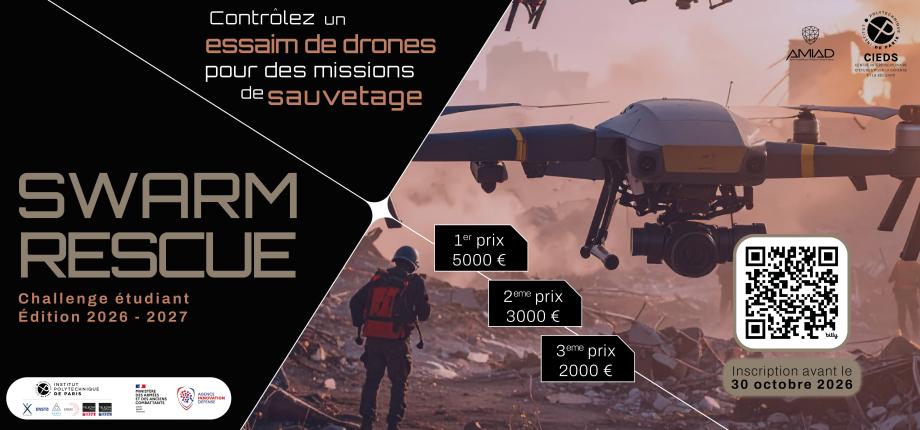
Swarm Rescue Challenge 2026–2027: Save lives by programming a drone swarm!
Lead a rescue mission in an unknown environment
Each team is tasked with developing algorithms that enable a swarm of drones to explore an unknown, hard-to-reach, and potentially hazardous area in order to rescue people who may be lying motionless or on the ground and guide them to a safe area.
The scenario is inspired in particular by search-and-rescue operations in the basements of collapsed buildings, where victims may be trapped in darkness and smoke. The drones must locate them and guide them to a safe exit so that they can be rescued.
In a Python simulation, each team is equipped with a fleet of 10 drones, each fitted with:
- a limited-range communication system that may be subject to jamming;
- a laser rangefinder (LiDAR) to measure distances to obstacles;
- a semantic sensor that can identify the nature of an object without image processing;
- a GPS receiver, which may be unavailable in certain areas.
Each drone also sustains damage every time it collides with the environment or other drones, potentially leading to its destruction.

Applying and supporting teams
All students from schools that are members of Institut Polytechnique de Paris (École Polytechnique, ENSTA, Télécom Paris, Télécom SudParis, ENPC and ENSAE), as well as students from institutions overseen by the French Ministry for the Armed Forces and Veterans Affairs (ISAE-SUPAERO, French Air and Space Force Academy and École Navale), are eligible to take part in the competition.
No specific technical expertise is required to participate, apart from knowledge of the Python programming language. Above all, the challenge encourages participants to draw on their creativity and scientific thinking.
Throughout the competition, teams will receive support from the organising team, which comprises experts in autonomous navigation, exploration and multi-drone coordination. This guidance will enable students to develop original and innovative solutions addressing the challenges of navigation, exploration and victim assistance.
Schedule for the 2026–2027 edition
- 20 October 2026: introductory session and launch of the challenge
- 8 December 2026: first interim assessment
- 26 January 2027: second interim assessment
- 18 March 2027: final assessment using an unfamiliar map, followed by project presentations to a panel of experts
Highlights from the previous edition
Winning French Teams
- First place was awarded to André Poix, Mathias Anseaume and Antonin Granados from Télécom Paris.
- Second place went to Nguyen Van Khue, Anhad Singh Narang, Quoc Viet Tran and Marc Elie Abouchar from École Polytechnique.
- Third place was awarded to Étienne Pelissier and Iba Demesy from Télécom Paris.
Winning Indian Teams
- First place went to Nirmal Kumaran, Gowsik Gurudev, Smitha and Sri Charan from IIT Madras.
- Second place went to Nandhini S, Shubhankit Tewari, Ajan Muthuraj, Sudharsan K and Narayani Adane from IIT Madras.
- Third place went to Harshinni B, Kaarthik N, Jaanav Mathavan and Santhosh Kumar R. from IIT Madras.
The Swarm Rescue Challenge offers a unique opportunity for students at Institut Polytechnique de Paris and institutions overseen by the French Ministry for the Armed Forces and Veterans Affairs to put their creativity and curiosity to the test by programming a swarm of drones for rescue missions that tackle real-world challenges with meaningful impact!
The Swarm Rescue Challenge is supported by the Defence Innovation Agency.