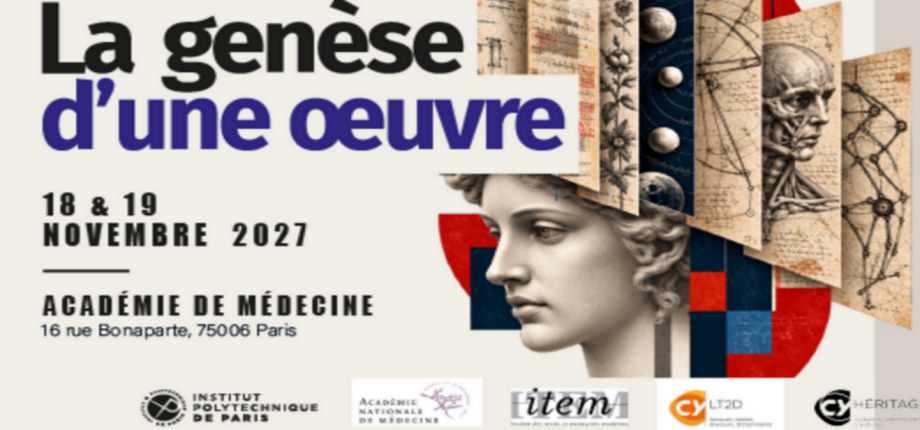
Very often, the reader picks up a finished book, definitively set in stone at the end of a long editorial process, which thus presents a work frozen in time and preserved for posterity. Whether literary, technical or scientific, the work is nevertheless the result of a journey whose existence can be glimpsed through the drafts. It is precisely this somewhat mysterious before often overlooked that this conference aims to explore. To the finished work belongs the light of the world; to the initial manuscript, the genesis of thought in motion, of writing in the making. This genetic perspective on texts applies equally to scientific and literary writings. But do authors whoever they may be have the same handwriting, the same way of crossing things out, the same writing processes ? How does a scientific discovery come about ? Is there a ‘scientific mind’ that can be identified, discerned or traced in the drafts of a mathematician, a physicist or a chemist ? Has the style of writing remained similar from the Middle Ages to the most contemporary periods? Does a writer such as Ronsard, who spent his life revising successive editions of his texts, enable us to define and understand his body of work ? In short, should we unearth the first edition, or regard the final version corrected in his own hand decades later as definitive and unique ? The genesis of "J’accuse"…! Can the archives at the offices of "L’Aurore" help us to understand the text printed on the morning of 13 January 1898 ? These questions also prompt us to consider the fate of writers’ archives. Since the second half of the 20th century, many authors have entrusted their manuscripts to the Bibliothèque nationale de France (including Edmond Jabès, Hélène Cixous, Nathalie Sarraute, Pierre Guyotat, Annie Ernaux and Édouard Glissant, whose archives are held at the BnF). Whether bequeathed or acquired, these archives (whether comprehensive or partial) make a genetic study possible, whilst subjecting the pre-texts to classification, description and, in some cases, digitisation. How do these interventions, which take place after the writing process, shape our reading of the work ? An author’s intent may be discerned between the lines in their drafts. But what of a work published without the author’s initiative ? Consider the fragments of Pascal’s "Pensées". Would he recognise the work we read today and perceive as, in a sense, a complete book ? The same applies to the history of dictionaries. What additions / omissions / corrections / amendments took place between the very first edition of the Académie française’s dictionary in 1698 and the 9th edition presented to the President of the Republic in 2025 at the Institut de France? Between manuscript and printed text, between private archive and collective heritage, between initial formulation and finalised version, the multiple temporal dimensions of the work thus take shape. The conference aims to examine the processes of writing, rewriting, selection, editing and preservation that contribute to its creation. The aim will be to examine the material, intellectual and institutional conditions through which a text, a body of knowledge or a discovery attains a public form and, at times, an apparent permanence. This conference thus seeks to explore the cross-cutting issue of the genesis of texts across the centuries and across all fields of knowledge. We therefore welcome proposals for papers in the following areas:
- Scientific and technical
- Texts Literary
- Texts Scientific archives
- Codicology and palaeography
- Textual genetics from the Middle Ages to the 21st century
- The study of ancient and modern manuscripts History of manuscripts
- History of the book Genetic criticism / the history of book
- Interpretation and writing
- Writers’ libraries
- Publication and reprints of the same work
- Dictionary collections / history of dictionaries
- Ancient texts / modern texts
- Drafts / marginal notes / palimpsests
Organisers :
Institut Polytechnique de Paris (Centre for French Studies)
École polytechnique
Institute for Modern Texts and Manuscripts / CNRS-ENS / PSL
CY Cergy University (CNRS-Héritages and UR-LT2D laboratories)
National Academy of Medicine
Calendar :
- Conference launch: October 2026
- Deadline for paper submissions: 1 March 2027
- Announcement of results and finalisation of the programme: 15 April 2027
- Dates of the international conference: 18 and 19 November 2027 in Paris
Place :
- 18 November 2027: National Academy of Medicine – 16 Rue Bonaparte, 75006 Paris
- 19 November 2027: École normale supérieure (ENS) – 45 Rue d’Ulm, 75005 Paris
Submission :
Presentations (excluding plenary sessions) at this conference will last 30 minutes (20 minutes for the presentation + 10 minutes for questions). The two official languages of the conference are French and English.
Proposals for papers must be submitted to Cécile AUBÉ (cecile.aube@polytechnique.edu) by 1 March 2027 at the latest, in the form of an abstract (one page maximum). The scientific committee will give its decision by 15 April 2027 at the latest.
Plenary sessions :
- GESTEN Hélène (author)
- RIFFARD Claire (Institute of Modern Texts and Manuscripts / CNRS-ENS / PSL)
- SAUER Tilman (University of Mainz)
- VAN WYHE John (University of Singapore)
Presentation of the Committees
Organising committee
BERTRAND Olivier, Cergy Paris Université, École polytechnique et IP Paris, LT2D
FERRAND Nathalie, Institute of Modern Texts and Manuscripts, CNRS-ENS / PSL
FORT Pierre-Louis, Cergy Paris Université, CNRS UMR Héritages
SCHAFFNER Isabelle, École polytechnique, LinX, CNRS UMR ITEM
AUBÉ Cécile , École polytechnique et IP Paris, project manager
Contact : cecile.aube@polytechnique.edu
Scientific committee
ADAMSBAUM Catherine, Paris-Saclay Faculty of Medicine, National Academy of Medicine
BERTRAND Olivier, École polytechnique, IP Paris, Cergy Paris Université, Lexiques Laboratory, Texts, Dictionaries
BUCHWALD Diana, California Institute of Technology (Caltech)
CHAUDOREILLE Hélène, École polytechnique
DUMONTET Fabienne, ENS Lyon, Institute for the History of Representations and Ideas in Modernities
DUPOND Marie, ENS-ULM, Association François Guizot / Ecole des Chartes
FERRAND Nathalie, Institute of Modern Texts and Manuscripts, CNRS-ENS / PSL
FORT Pierre-Louis, Cergy Paris Université, CNRS-Héritages
LE COZ Pierre, Aix-Marseille Université, National Academy of Medicine
MARGUIN-HAMON Elsa, École des Chartes - PSL
MUSITELLI Pierre, ENS-ULM Laboratoire CNRS ITEM (Institute of Modern Texts and Manuscripts)
REY Christophe, Cergy Paris Université, Institut Universitaire de France,
SAUER Timan, University of Mainz
SCHAFFNER Isabelle, École polytechnique, CNRS ITEM et LinX, IP Paris
VAN WYHE John, University of Singapore
VEYSSEYRE Géraldine, Sorbonne University, Sens, Text, Computing and History Laboratory
Bibliography and web references
See the very comprehensive bibliography in the BnF “repères” collection Writers’ Drafts:
- https://expositions.bnf.fr/brouillons/reperes/index.htm
- https://essentiels.bnf.fr/fr/livres-et-ecritures/formes-et-usages-des-livres/c8ae2657-1953-4be3-85c4-3a3f6216e077-page