



Chair ASC production
Core Academic Themes
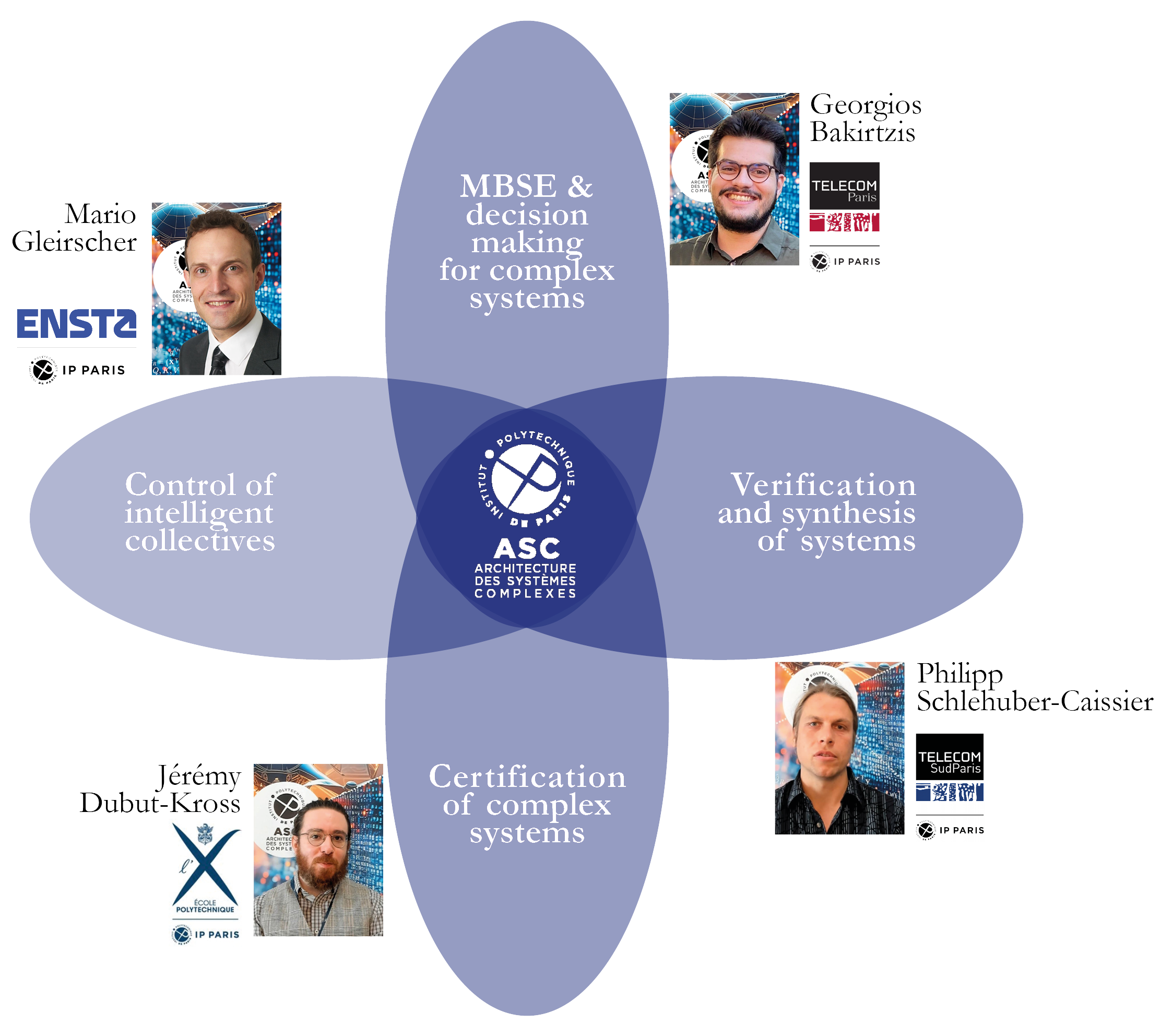
The Chair is structured around four teams across four schools, each focusing on distinct yet complementary fields of teaching and research
. . . . . . . . . . . . . . . . . . . . . . . . . . . . . . . . . . . . . . . . . . . . . . . . . . . . . . . . . . . . . . . . . . . . . . . . . . . . . . . . . . . . . . . . . . . . . . . . . . . . . . . . . . . . . . . .
More than 10 exchange and dialogue procedures are currently underway, aimed at validating the opportunity to launch specific research projects involving industrial partners, government stakeholders, and the four participating schools. (Details not disclosable)
Four CIEDS projects in the fields of robotics and modeling currently involve the stakeholders of the ASC Chair." (Details not disclosable)
Please find here all the publications : https://ip-paris.hal.science/search/index?q=collCode_s%3AASC
A few examples of scientific publications :
Correct-by-construction requirement decomposition
Georgios BAKIRTZIS
Correct-by-construction requirement decomposition / Décomposition des exigences correcte par construction
In systems engineering, accurately decomposing requirements is crucial for creating well-defined and manageable system components, particularly in safety-critical domains. Despite the critical need, rigorous, top-down methodologies for effectively breaking down complex requirements into precise, actionable sub-requirements are scarce, especially compared to the wealth of bottom-up verification techniques. Addressing this gap, we introduce a formal decomposition for contract-based design that guarantees the correctness of decomposed requirements if specific conditions are met. Our (semi-)automated methodology augments contract-based design with reachability analysis and constraint programming to systematically identify, verify, and validate sub-requirements representable by continuous bounded sets---continuous relations between real-valued inputs and outputs. We demonstrate the efficacy and practicality of a correct-by-construction approach through a comprehensive case study on a cruise control system, highlighting how our methodology improves the interpretability, tractability, and verifiability of system requirements.
More informations :
Safety Assurance under Uncertainties From Software to Cyber-Physical/Machine Learning Systems
Jérémy DUBUT
Ensuring the safety of software systems has never been as pressing an issue as it is today. Practitioners and researchers addressing this challenge face a unique problem inherent to modern software systems: uncertainty. On the one hand, the cyber-physical nature of modern software systems—exemplified by automated driving systems—requires addressing environmental uncertainties and mitigating the associated risks. Additionally, the proliferation of statistical machine learning components and massive numerical computation units for statistical reasoning, such as deep neural networks, makes these systems difficult to explain, understand, analyze, or verify.
This book is the first to provide a comprehensive overview of these unified and interdisciplinary efforts. Using automated driving systems as a primary example, it describes various techniques for specifying, modeling, testing, analyzing, and verifying modern software systems.
In his field of expertise, Jérémy Dubut-Kross co-authored the chapter "Formal Specification of Temporal Properties," which serves as a foundation for many other chapters in the book. This chapter introduces what are known as formal specifications. Formal specifications are essential whenever one seeks to automatically verify whether a system behaves as expected for a given input. They are therefore indispensable in numerous testing and verification methods.
"Safety Assurance under Uncertainties" is thus a seminal work that belongs in the libraries of all organizations involved in the validation of critical systems.
More informations :
Petri Nets and Higher-Dimensional Automata
Philipp SCHLEHUBER
Petri Nets as Higher-Dimensional Automata Petri nets and their variants are often studied through their interleaving semantics, that is, by considering executions where only one transition occurs at each step. This clearly represents a limitation, as Petri nets are inherently a model of true concurrency. This paper revisits the semantics of Petri nets as higher-dimensional automata (HDAs), as introduced by van Glabbeek, which systematically account for concurrency.
The authors extend the translation to include common features. They consider nets with inhibitor arcs under the two concurrent semantics used in the literature, as well as generalized self-modifying nets. Finally, the authors present a tool implementing their translations.
More informations :
| Séminaire 10 Complex Systems | Complex systems seminars Kyriakos G. Vamvoudakis Title: Learning to sense and act: Data-driven sensor and actuator selection for resilient complex systems When: July 17th 2026 Lien vidéo |
| Séminaire 9 Complex Systems | Complex systems seminars David Fridovich-Keil Title: Hierarchical, game-theoretic models of noncooperative interaction When: June 12th 2026 Lien vidéo |
| Worshop NEXUS : Neurosymbolic eXplainable Trustworthy Systems / 25 mai 2026 | Co-organisation par Georgios Bakirtzis du workshop NEXUS lors de AAMAS 2026 Date 25 mai 2026 Lien |
| Séminaire privé "D" des partenaires ASC / 19 mai 2026 | Séminaire d'échange autour des enjeux de la robotique, des drones et de la place de l'IA dans les systèmes de défense. |
| Séminaire 8 Complex systems | Complex systems seminars Jandson S. Ribeiro A tour through knowledge dynamics : To infinity and beyond When: Mai 10th 2026 Lien vidéo |
| Séminaire 7 Complex systems | Complex systems seminars |
| Séminaire privé "C" des partenaires ASC / 09 septembre 2025 | Séminaire d'échange autour des enjeux de la robotique, des drones et de la place de l'IA dans les systèmes de défense. |
| Séminaire 6 Complex systems | Complex systems seminars Title: Formal verification of AI systems When: December 15th 2025 Lien vidéo |
| Séminaire 5 Complex systems | Complex systems seminars |
| Séminaire 4 Complex Systems | Complex systems seminars |
| Séminaire 3 Complex Systems | Complex systems seminars Title: Formal Verification for Multi-Agent Systems: Theory and Practice When: Oct 22 at 14:00 CEST Lien vidéo Lien Post |
| Séminaire privé "B" des partenaires ASC / 09 septembre 2025 | Séminaire d'échange autour des enjeux de la robotique, des drones et de la place de l'IA dans les systèmes de défense. |
| Séminaire Systèmes de systèmes Opération CIEDS 2025 / 03 juillet 2025 (vidéos bientôt disponibles) | Keynote "les systèmes de systèmes de demain" par l'IGA Delphine La modélisation MBSE UAF sous CatiaMagic des systèmes de systèmes de défense par Gauthier Fanmuy (Dassault Systèmes) Utilisation des méthodes formelles pour la sureté de fonctionnement des systèmes critiques |
| Séminaire 2 Complex Systems | Complex systems seminars Title: Compositional design of society-critical systems: From autonomy to future mobility When: June 10th at 14:30 CEST Lien vidéo Lien post |
| Séminaire 1 Complex Systems | Complex systems seminars Title: Compositional design of society-critical systems: From autonomy to future mobility When: June 10th at 14:30 CEST Lien vidéo Lien post |
| Séminaire privé "A" des partenaires ASC / 22 mai 2025 | Séminaire d'échange autour des enjeux de la robotique, des drones et de la place de l'IA dans les systèmes de défense. |
| Atelier hebdomadaire MBSE UAF d'un système de systèmes de défense | Début des ateliers hebdomadaires pour concevoir la méthodologie de modélisation MBSE selon le framework UAF d'un système de systèmes de défense. Participation de tous les partenaires ASC à ces ateliers et production des use-cases du Challenge ASC. |
| Journée Scientifique ASC 2024 / 15 mars 2024 | Intervention École polytechnique Intervention ENSTA Intervention Télécom Paris Intervention Télécom SudParis |