



Underwater Acoustics: Understanding Wave Propagation and Submarine Noise
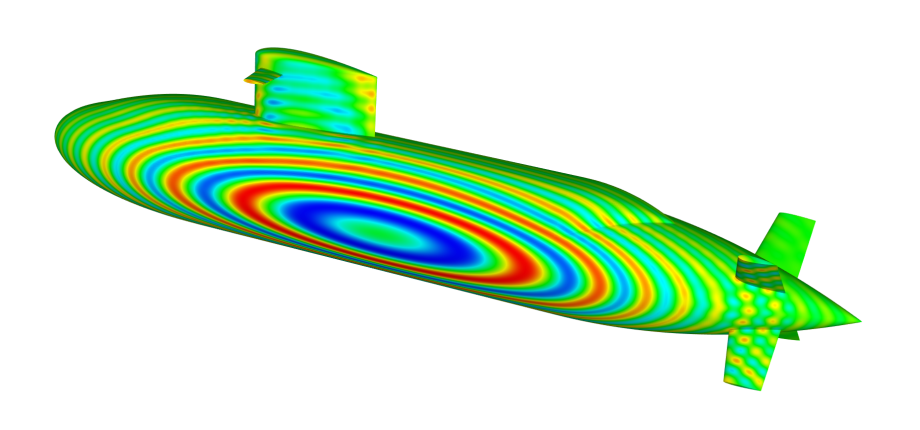
A submarine moves along the ocean floor. Nearby, an explosion occurs, and the submersible is struck by the resulting shock wave. How does this wave propagate from the site of the blast to the submarine? What are the consequences for the vessel? These are the kinds of questions addressed by Stéphanie Chaillat, CNRS research director and member of the POEMS laboratory at ENSTA.
“Naval Group approached us—Marc Bonnet (also a research director at POEMS) and myself—to study the interactions between explosions and submersibles,” explains the mathematician. In this context, she applies her modeling methods to underwater acoustics and helps the company develop numerical tools to simulate various scenarios and phenomena, ultimately enabling improved vessel design.
Accuracy and Intelligent Coupling
Together with Marc Bonnet, she co-supervised an initial PhD thesis focused on modeling two consequences of explosions affecting submarines: the propagation of the shock wave and the gas bubble formed by the detonation.
“In the first case, we proposed a numerical method that allows the phenomenon to be simulated quickly. We assumed the ocean to be an infinite homogeneous medium and treated the wave as a linear acoustic wave,” explains Stéphanie Chaillat. The researchers relied on methods for solving partial differential equations and on specific mathematical tools (Green’s functions) to model this phenomenon. “Because the ocean is an open medium, the model must incorporate boundary conditions that represent wave propagation toward infinity,” she adds.
However, the work did not stop at modeling the wave’s progression from the explosion site. When the wave reaches a submarine, the structure reacts and in turn emits waves.
In the second case, it was necessary to account for the significant impact of the motion of the gas bubble on the vessel. This relatively slow movement constitutes a quasi-static physical phenomenon, meaning it is nearly in equilibrium at any given moment. Relatively simple mathematical tools—Laplace equations—were sufficient to model it.
“One of the major challenges of this first thesis was to model these phenomena without approximations, which typically requires very costly high-performance computations. Thanks to our simulation method, we approximate these calculations without actually performing them, while maintaining a high level of accuracy.” The POEMS laboratory can thus generate maps of pressure or deformation fields on a submarine’s hull and provide industry partners with precise tools tailored to their computational capabilities.
Another challenge was addressed in a subsequent thesis: efficiently coupling the behavior of the submarine with that of the surrounding ocean. Until then, a simple but imperfect method had been used, which did not accurately reflect reality. The goal here was to revisit the theoretical foundations of the coupling method and propose an optimal, functional, and reliable version, validated both theoretically and numerically. “I am particularly proud of this second thesis, as it received two national awards: one from the French Association of Mechanics and another from the AMIES (Mathematics–Industry) association,” says Stéphanie Chaillat, who also co-supervised this work with Marc Bonnet.
At the same time, the researcher collaborated on two additional PhD theses (alongside Jean-François Mercier, CNRS research director and member of POEMS) aimed at developing numerical tools for predicting and finely analyzing noise radiated by submarines.
“Water flows along submersibles generate vortices that can cause certain components to vibrate. These parts then become sources of noise and vibro-acoustic radiation that must be avoided so as not to reveal and betray the presence of submarines,” she explains. By again relying on Green’s functions, it becomes possible to precisely identify these sources, even in complex geometries, and provide naval designers with valuable information to develop submarines that are as stealthy as possible.
AI and Modeling
The introduction of artificial intelligence—more specifically neural networks—represents the next step in improving numerical methods for these phenomena.
“In my view, AI will not replace numerical solvers, but deep learning can help me learn approximations and refine those I already use. Conversely, I can rely on simulation and modeling to improve neural network architectures.”
This dynamic is reflected in the courses she teaches in the Analysis, Modeling, and Simulation (AMS) master’s program run by Institut Polytechnique de Paris and Université Paris-Saclay. There, she introduces students to recent algorithmic approaches used to simulate realistic phenomena based on integral equation methods.
“The idea is to show future scientists that AI can be enhanced by numerical simulation, and that the boundary between the two is very thin.”
À propos de Stéphanie Chaillat
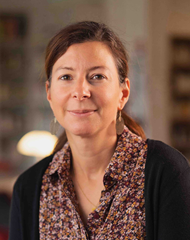
Stephanie Chaillat is a senior research scientist at CNRS working at the interface between computational mechanics and applied mathematics. Her research is driven by realistic physical phenomena and industrial challenges. She develops fast algorithms and numerical methods to study large-scale wave propagation problems, such as acoustic and seismic wave propagation. In recent years, she has collaborated closely with Naval Group on topics related to underwater acoustics. Since 2025, Stephanie Chaillat have served as Deputy Director of the POEMS laboratory. From 2022 to 2024, she was an Adjunct Faculty member in the Department of Geophysics at Stanford University. Prior to joining CNRS, she worked as a Postdoctoral Associate at the College of Computing at Georgia Tech. She earned her PhD in Mechanical Engineering from École Polytechnique in France. Her expertise lies in the development of numerical methods for partial differential equations and ordinary differential equations, with a focus on fast algorithms and efficient (parallel) programming.She is passionate about pushing the boundaries of computational science and continuously expanding her research horizons. Currently, she is exploring how machine learning can accelerate the solution of wave propagation problems, aiming to harness its potential for improving computational efficiency and accuracy in complex simulations.
>> Stéphanie Chaillat on Google Scholar
>> The Page of Stéphanie Chaillat on POEMS website
POEMS : a joint research unit CNRS, ENSTA Paris, Institut Polytechnique de Paris, 91120 Palaiseau, France