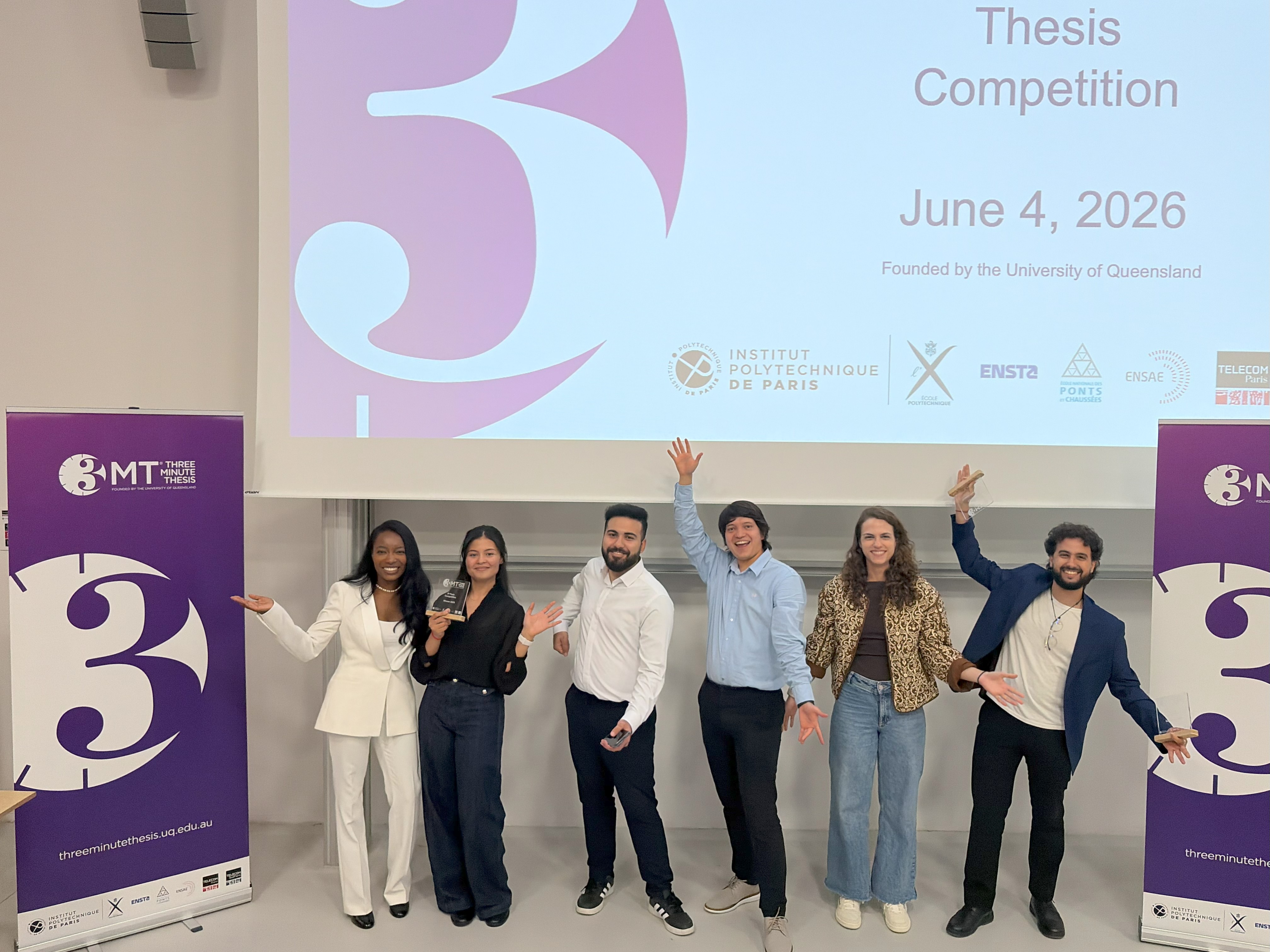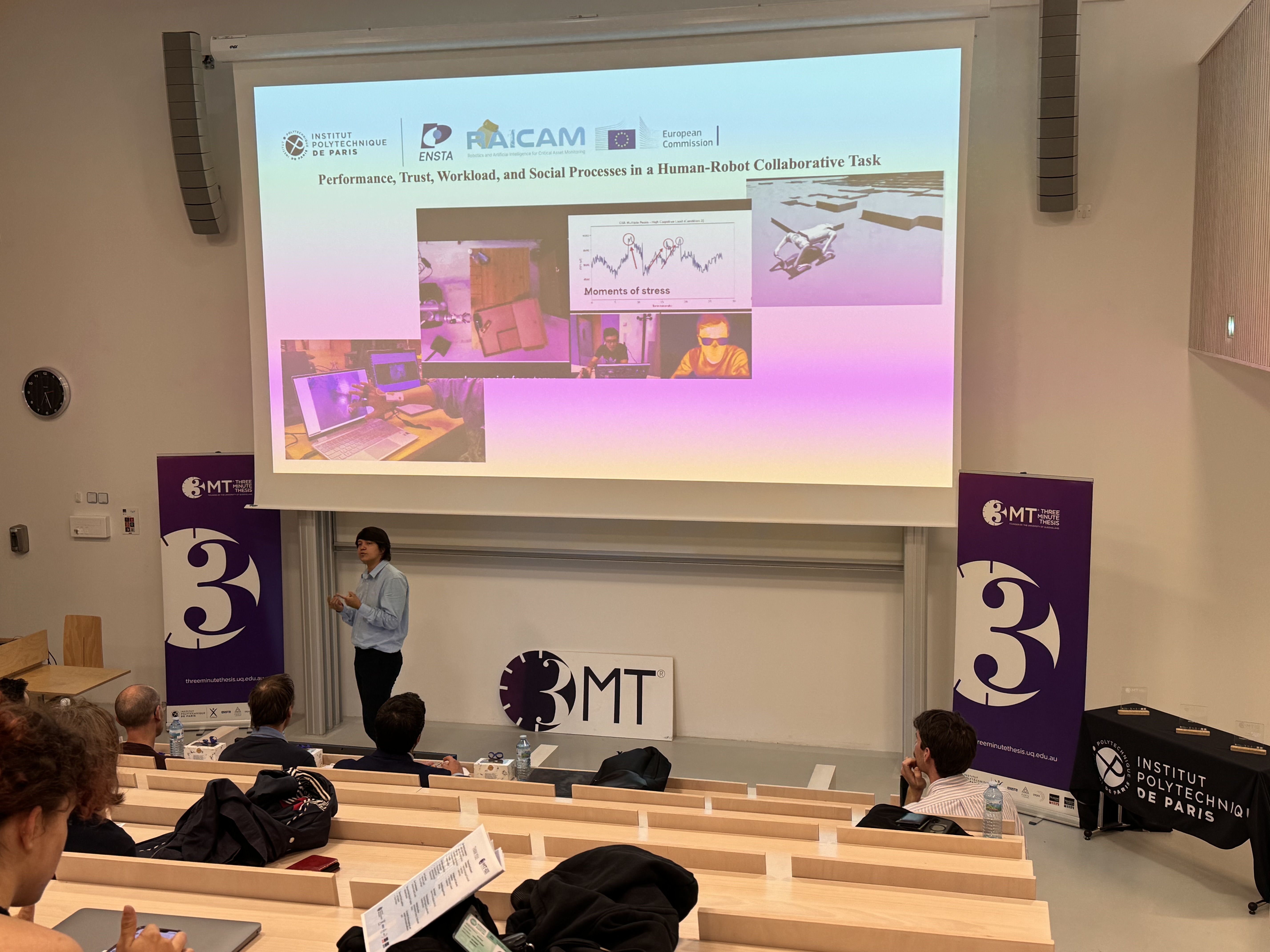



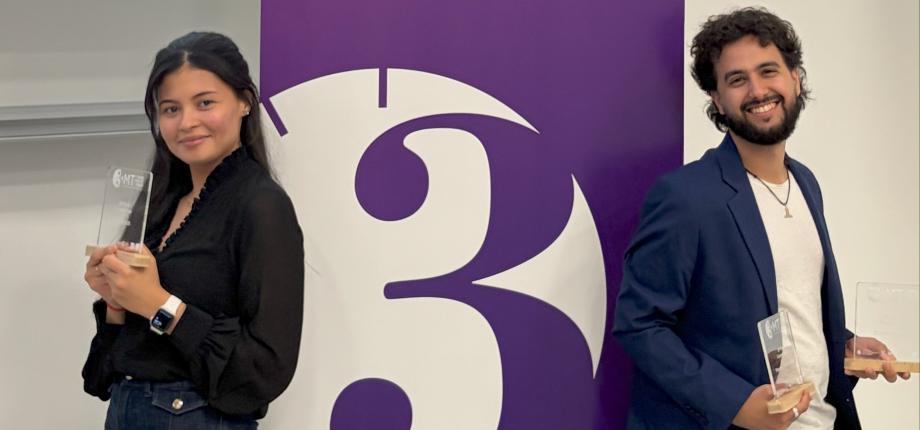
Safa Gharbi and Juan Lorenzo Santana Gonzalez win the 2026 IP Paris 3MT® Competition
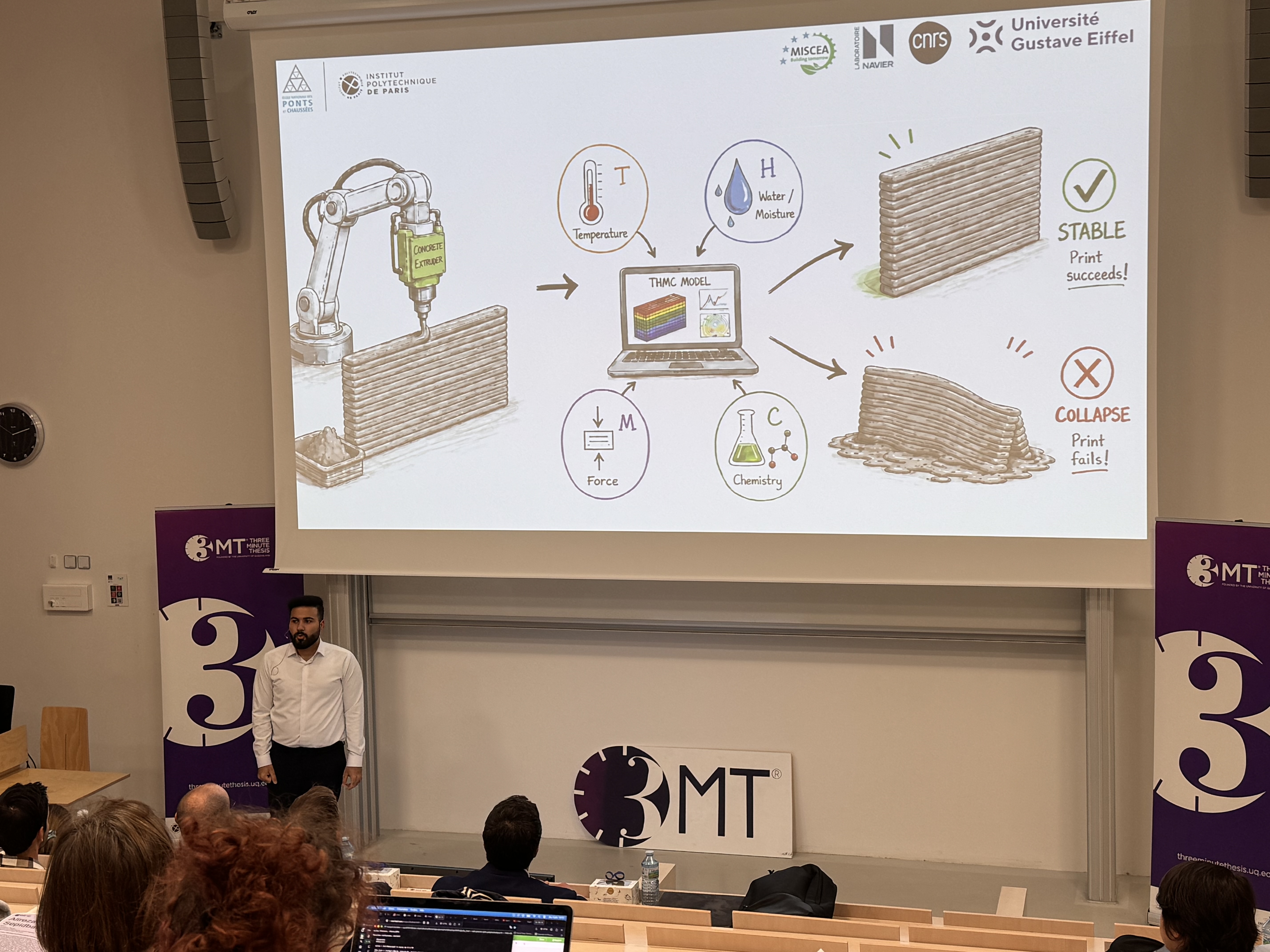
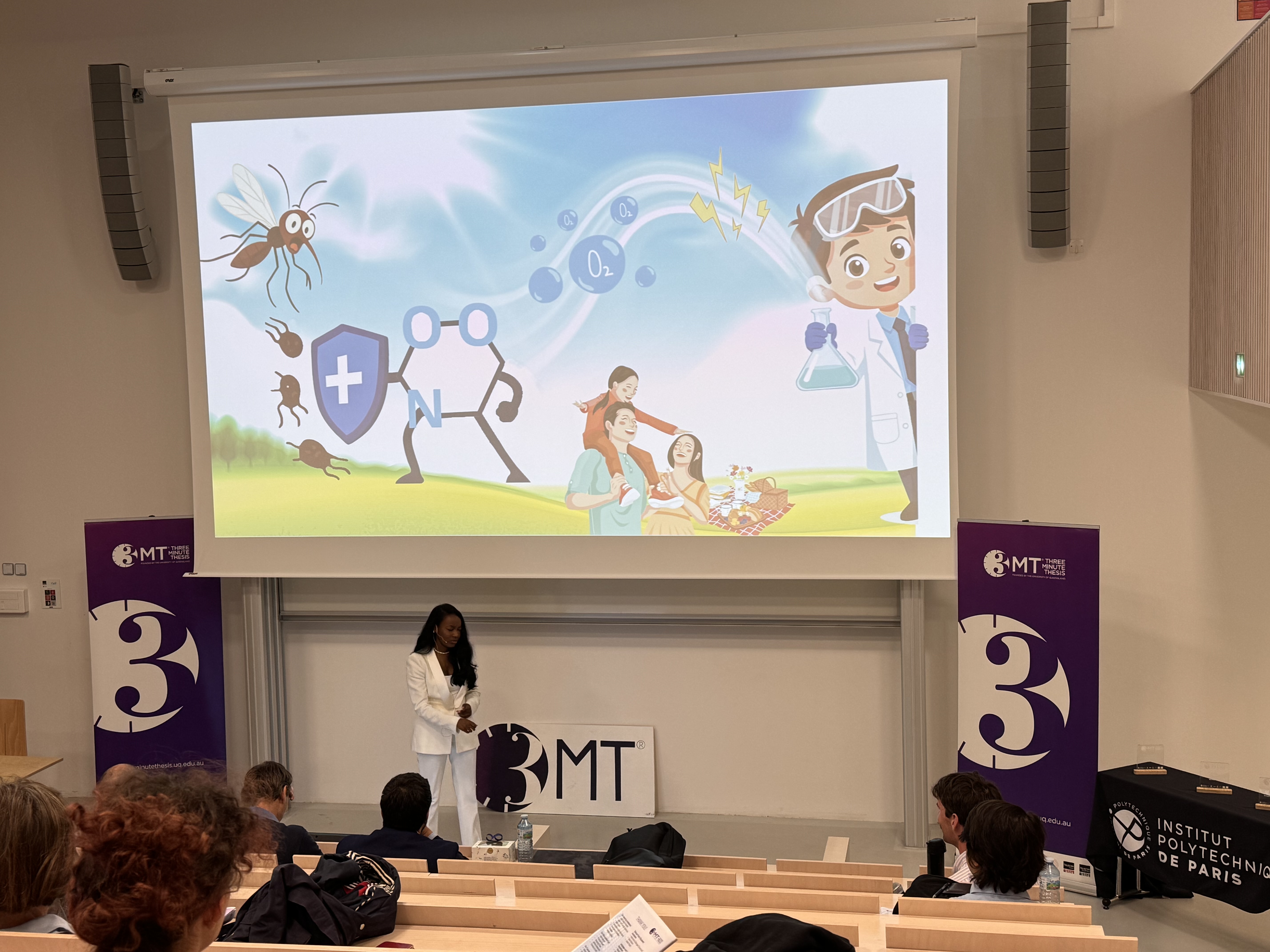
Six PhD candidates presented their research in English to a non-specialist audience on Thursday, June 4, at Télécom Paris. All were affiliated with laboratories of Institut Polytechnique de Paris.
Two of them stood out by convincing both the audience and the jury with clear, engaging, and accessible presentations:
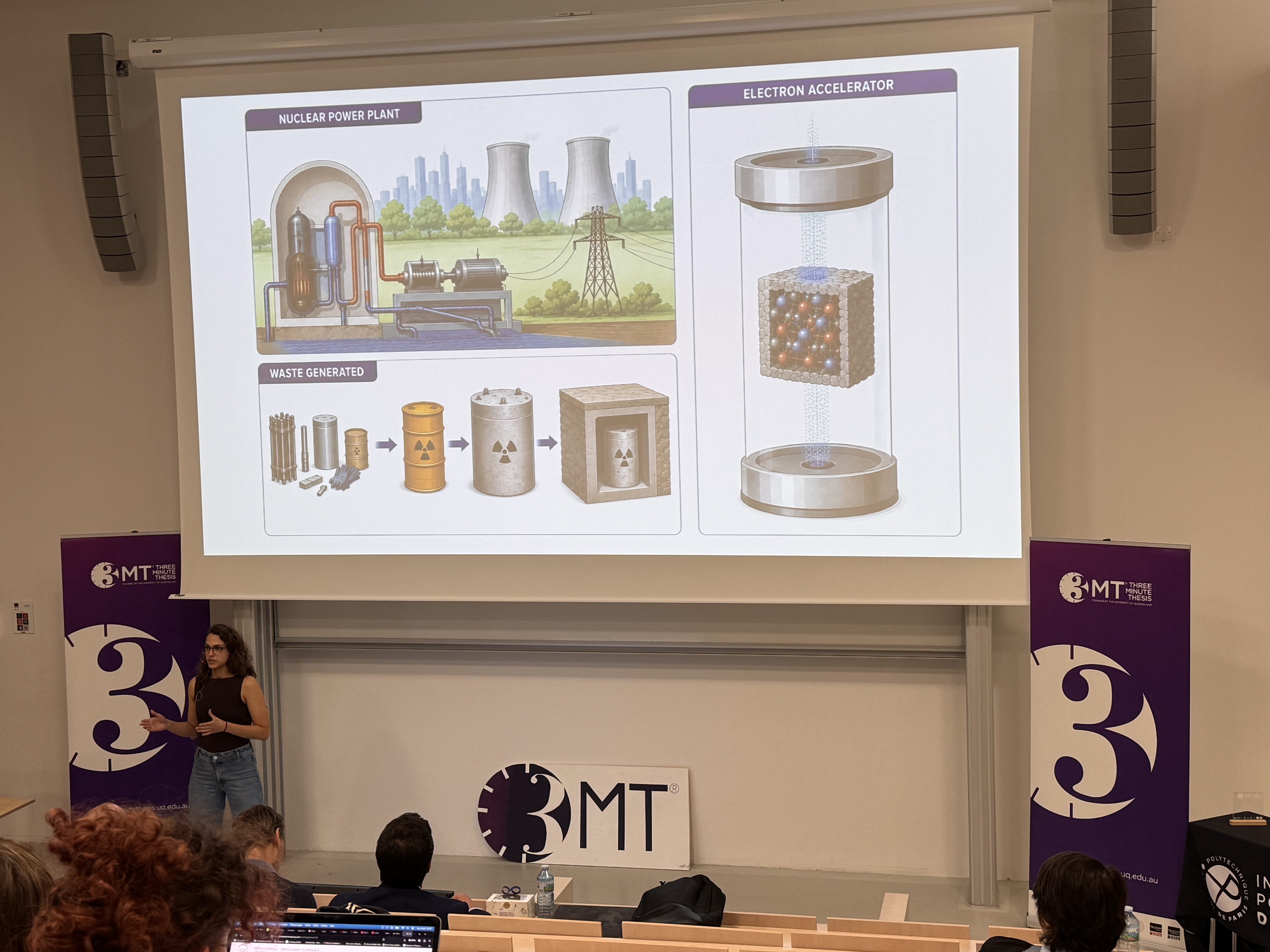
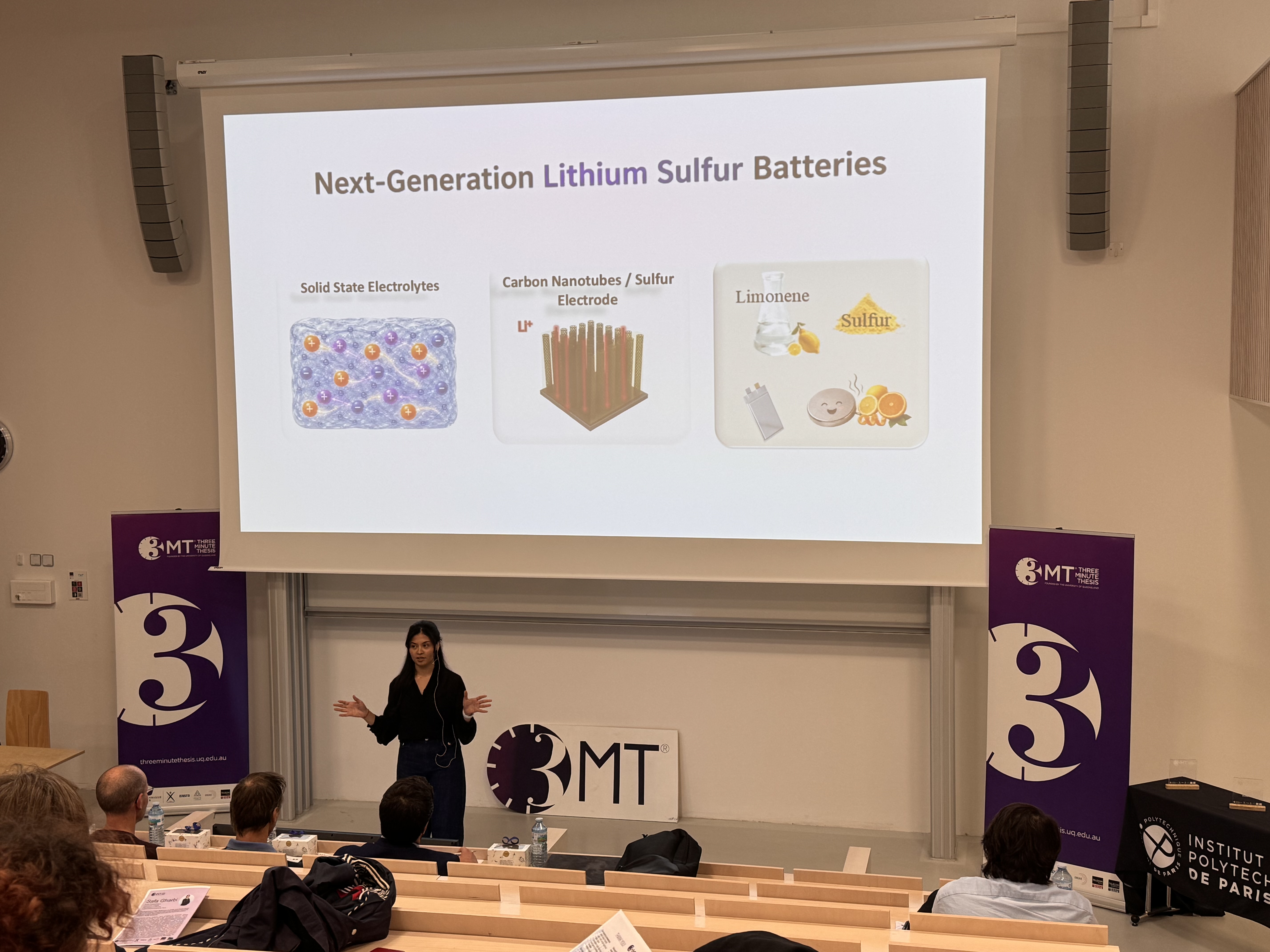
>>Safa Gharbi, a PhD candidate at the Laboratory of Physics of Interfaces and Thin Films (LPICM*) at École Polytechnique, was awarded the First Prize by the jury. Her thesis, entitled "Development of High-Performance Solid- and Quasi-Solid-State Electrolytes Coupled with Sulfur-Infiltrated Vertically Aligned Carbon Nanotube Cathodes for Next-Generation Lithium–Sulfur Batteries", aims to make lithium–sulfur batteries more efficient, safer, and more environmentally friendly by developing new solid electrolytes that enhance their lifespan and energy performance.
What is your PhD research about?
My PhD research focuses on the development of next-generation lithium–sulfur batteries. These batteries offer a significantly higher energy potential than current lithium-ion technologies, but their deployment is still limited by several scientific and technological challenges. My work involves designing new solid and quasi-solid electrolytes that are safer and more efficient, with the aim of improving the stability and lifespan of these batteries. These are combined with a novel nanostructured hybrid electrode made of vertically aligned carbon nanotubes infiltrated with sulfur, without additives. I also explore more environmentally friendly approaches to make these batteries more sustainable. The goal is to contribute to the development of safer, more durable energy storage solutions that meet the needs of the energy transition.
What motivated you to pursue a PhD in this field?
I have always wanted to explore a field I am passionate about and deepen my understanding of scientific phenomena. This interest was confirmed in 2020 during an initial internship focused on lithium–sulfur batteries, where I discovered the field of energy storage. Joining a physics laboratory to continue my research on this technology was a great opportunity to combine several disciplines at the intersection of physics, chemistry, materials science, and electrochemistry. Today, this PhD is a true source of personal fulfillment and allows me to contribute, at my own level, to the development of technologies that are essential for the energy transition.
Why is it important for you to communicate your research to the general public?
Science communication helps spark curiosity, inspire vocations, and strengthen the connection between researchers and the public. By making sometimes complex concepts more accessible, I aim to raise awareness about the challenges of energy storage and its essential role in the development of renewable energy and electric mobility. It is also an opportunity to show how our research contributes to the development of the batteries of tomorrow.
What does the 3MT competition represent for you, and what do you expect from this experience?
The 3MT competition represents much more than just an exercise for me. It has allowed me to take a step back from several years of research, extract the key ideas, and make them accessible to a broad audience. This enriching experience has also helped me develop my communication skills and share my passion for research with a wider public.
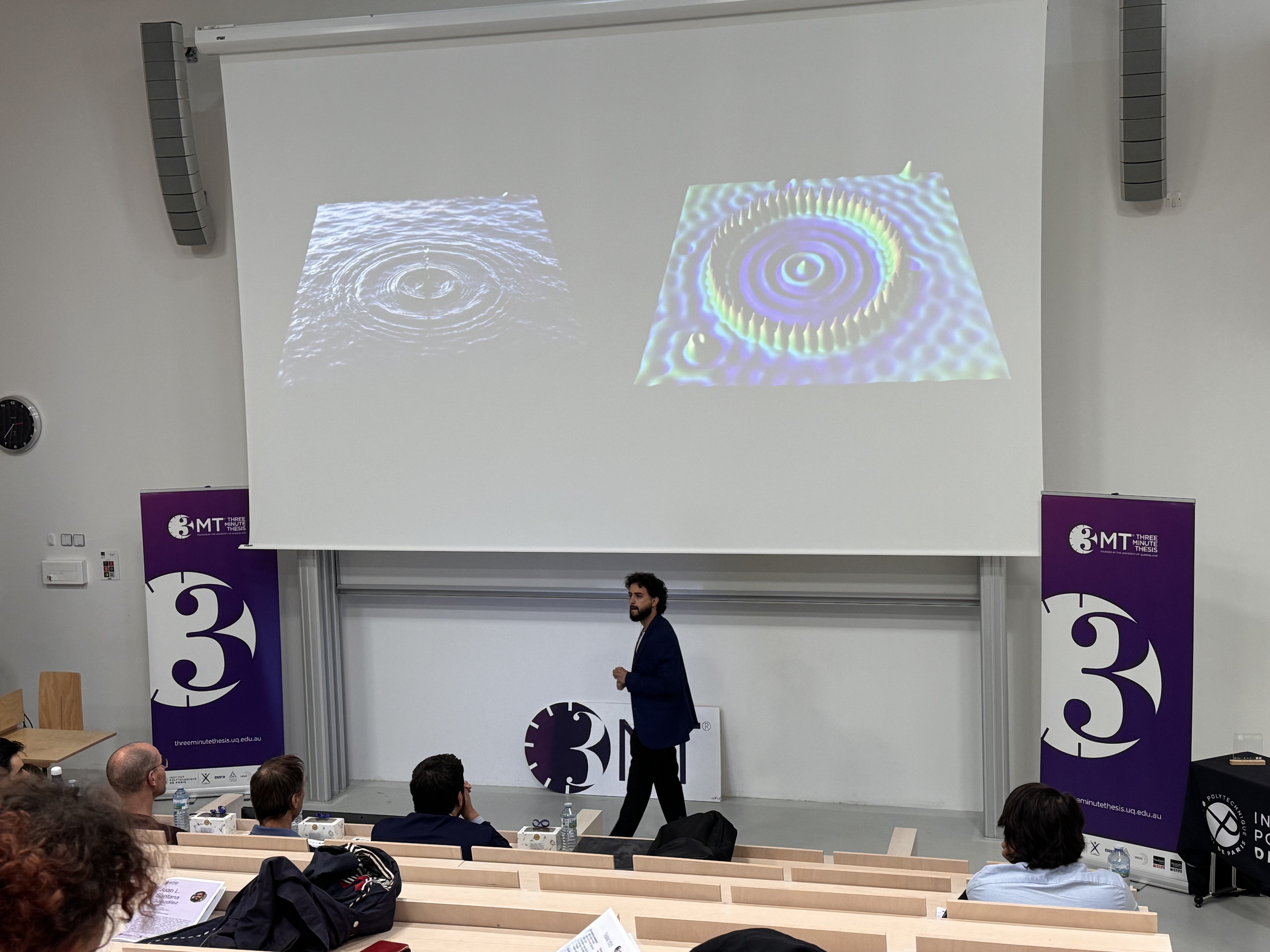
>>Juan Lorenzo Santana Gonzalez, a PhD candidate at the Laboratory of Irradiated Solids (LSI**) at École Polytechnique, received both the Second Prize from the jury and the Audience Award. His thesis, entitled “Looking at the Quantum Ocean”, seeks to understand why and how electrons pair up to form superconductivity—an state where electricity flows with zero resistance—by studying an intermediate and still mysterious phase known as the “strange metal.”
What is your PhD research about?
When electrons flow through a metal, they collide with each other and withsurrounding atoms, releasing energy as heat — we call this dissipation. It's why your laptop charger gets warm.
In 1911, physicist H. K. Onnes discovered that some materials, when cooledenough, enter a phase where dissipation drops to a perfect zero:superconductivity. Electrons pair up into "Cooper pairs" and merge into a singlequantum state, a kind of ocean spanning the whole material. Individualelectrons dissolve into it, and flow without any resistance.
But we still don't know what holds Cooper pairs together. I study how electrons behave just before they pair up, in a mysterious phase called the Strange Metal,where all electrons dissipate at exactly the same rate, set by fundamental constants of nature. I probe this by pushing electrons to extreme conditions: temperatures colder than outer space and the strongest magnetic fields on Earth, observing how they collide to uncover the hidden rules of theirinteractions.
What motivated you to pursue a PhD in this field?
Two concepts have fascinated me since I first encountered them: Universality - the idea that two seemingly unrelated systems can obey identical physicallaws - and Emergence, the fact that putting simple components together cangive rise to something completely unexpected, like life arising from atoms. Both are at the heart of my daily research. Superconductivity is emergent by nature,and the Strange Metal phase hints at a universal mechanism underlying all unconventional superconductors. As a fundamental physicist, I am not drivenby immediate applications, but by the conviction that answering the deepest questions always ends up being useful — even when we can't yet imagine how.
Why is it important to you to communicate yourresearch and present it to a wider audience?
Physics — and quantum mechanics in particular — has a reputation for beingin accessible. This stigma is harmful: it excludes potential contributors and,more importantly, it keeps the public disconnected from technology that isalready shaping their lives. We are living through the Second Quantum Revolution, with rapid advances in quantum sensing, communication and computing. Society deserves to understand what is happening and to have aninformed voice in how it is funded and regulated. Beyond technology, the gap between our laboratories and public understanding is a practical problem: in a world where scientific funding and trust in expertise are deeply political, that gap has real consequences.
What does the 3MT competition represent for you,and what do you expect from this experience?
The challenge was what drew me in from the start. Fundamental research is difficult to communicate: results are technical, and the impact is not always immediately visible. Distilling an entire thesis into three minutes — where everyword and every pause carries meaning — is a discipline I wanted to master. The training with professional communicators was a rare and invaluable opportunity. In general, the 3MT format embodies exactly what I believe science communication should be: short, direct, and genuinely engaging.
Congratulations also to Julia Castelo Pedrotti, also a PhD candidate at LSI, who placed third in the competition, as well as to Juan José Garcia Cardenas, Joséphine-Agnès Kourouma, and Alireza Sepidbar for the high quality of their presentations.
On to the interuniversity final
The two winners have qualified for the interuniversity final, which will take place on June 25, 2026, from 2:00 pm to 4:00 pm at Télécom Paris, in the Thévenin amphitheatre.
They will represent Institut Polytechnique de Paris alongside candidates from Université Paris-Saclay, Université PSL and HEC Paris.
Register now (free) to support them on June 25 and vote for the candidate you believe deserves the 2026 Audience Award.
* LPICM : a joint research unit CNRS, École Polytechnique, Institut Polytechnique de Paris, 91120 Palaiseau, France
**LSI : a joint research unit CEA, CNRS, École Polytechnique, Institut Polytechnique de Paris, 91120 Palaiseau, France