



[REFLEXIONS] Justice is key to successful energy transition
![[REFLEXIONS] Justice is key to successful energy transition](/sites/default/files/styles/actualite_full/public/actualites/images/2026-01/Article%20_Energy%20Justice_%20-%20C%C3%A9line%20Guivarch.png?itok=-o_4tLU_)
As sure as not everyone is equal in the face of climate change, no one is equal in the face of the energy transition either. Yet, energy justice often remains under the political and media radar. “If we don't address the issue of equity, we create untenable socio-economic situations,” warns Céline Guivarch, professor at École Polytechnique and Research Director at the École nationale des ponts et chaussées (ENPC).
The climate change economist will lead a round table discussion on climate justice – the third pillar of the energy transition alongside sustainability and security – at the Réflexions symposium organised by the Institut Polytechnique de Paris (IP Paris) on February 5.
The symposium aims to bring together scientific, industrial and political energy specialists to discuss the interconnections between the technological, economic, environmental and societal dimensions of the energy transition.
Three dimensions of justice
“Climate justice broadens the discussion beyond purely technological considerations by incorporating three dimensions of justice: distributive, procedural and recognition,” says Céline Guivarch, whose work at the Centre International de Recherche sur l'Environnement et le Développement (CIRED) aims to understand the extent of climate change's impact on our societies and to evaluate the paths to addressing this challenge.
Distributive justice focuses on those who, for example, benefit from energy systems and those who bear the costs. These inequalities can manifest themselves between countries, but also between generations, territories, genders or social classes. The second dimension – procedural justice – focuses on how decisions are made and implemented: who is involved? Who is excluded? Last, justice of recognition acknowledges that values differ across cultures and that imbalances inherited from the past, such as the legacy of colonial exploitation, must be taken into account, particularly in the context of climate finance negotiations.
Long neglected in the energy transition, justice is gradually gaining ground in public debate and political circles. “Since COP 27 in Egypt in 2022, the creation of a special fund has recognised the losses and damage caused by climate change and the need for an international response,” says Céline Guivarch, who contributed to the sixth report of the Intergovernmental Panel on Climate Change (IPCC) and is coordinating the next one.
No energy transition without equity
Within IP Paris, several laboratories are also conducting research on these topics. Among them, CIRED is focusing on how climate and energy policies reinforce or mitigate inequalities between countries and territories, but also how the measures taken in the context of transitions are perceived as fair or unfair. Similarly, the Laboratoire Techniques Territoires et Sociétés (LATTS**) studies the impact of solar and wind power on territories, taking into account their geography and sociology.
“Equity is at the heart of the obstacles to responding to climate change,” notes Céline Guivarch. “The energy transition cannot happen if it is not fair, if it does not provide broad access to low-carbon lifestyles by helping those who need it most to make the transition.” The round table on climate justice therefore invites everyone to reflect on how to design energy transitions that are not only sustainable and secure, but also fair and inclusive.
A video recap of the [REFLEXIONS] 2026 conference
*CIRED: a joint research unit CNRS, AgroParisTech, Cirad, École nationale des ponts et chaussées, EHESS
* *LATTS: a joint research unit CNRS, École nationale des ponts et chaussées, Université Gustave Eiffel
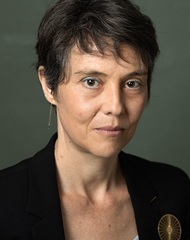
About Céline Guivarch
Céline Guivarch is Research Director at the Centre International de Recherche sur l'Environnement et le Développement (CIRED) at the École Nationale des Ponts et Chaussées. Before joining academia, she participated in a project related to climate change in Central Asia. This experience led her to pursue a PhD in the economics of climate change mitigation (2006) and, a few years later, to a one-year stint at the International Energy Agency's Climate Change Unit (2011). Since then, she has led CIRED's “Global Climate-Economy Modeling” team, whose work focuses on both the economic impacts of climate change and the assessment of mitigation pathways.
Céline Guivarch was the lead author of the chapter “Mitigation pathways consistent with long-term goals” in the IPCC Working Group III's Sixth Assessment Report on mitigation. She is a member of the French High Council for Climate, an independent body responsible for evaluating the French government's climate policy.
>> Céline Guivarch on the CIRED website
>> Céline Guivarch on Google Scholar