



IP Paris et l’ENSIP Paris and ENSTA Inaugurate an Air-Sea Testing Pool in BrestTA inaugurent un bassin d’expérimentation air-mer à Brest
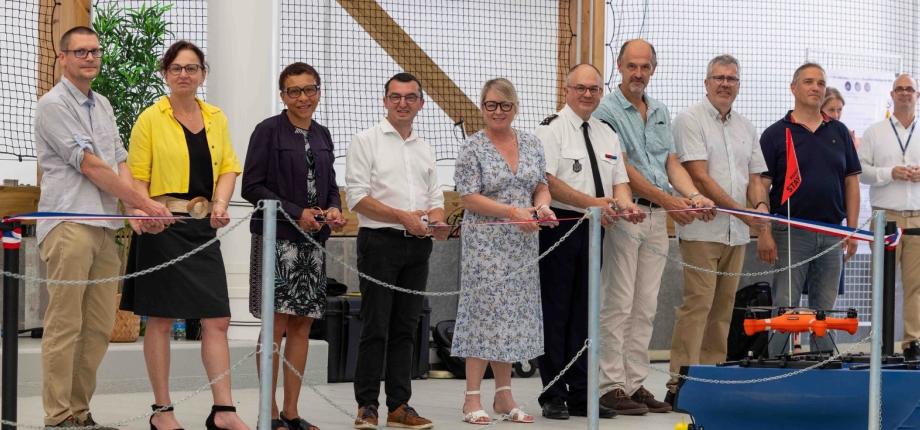
Institut Polytechnique de Paris and ENSTA inaugurated a true accelerator for maritime innovation in autonomous robotics, acoustic systems, and new mobile observation technologies this June 24, 2026, in Brest. A 900 m² building housing a testing pool and a large-scale drone cage now stands on the engineering school's Breton campus.
This new air-sea infrastructure was born from the realization that ocean knowledge, deep-sea exploration, and maritime surveillance require a full spectrum of aerial, marine, and underwater technologies. It also takes into account that industrial innovation requires smarter, more autonomous robots capable of communicating with each other and conducting long-duration missions. The air-sea pool thus makes it possible to experiment with tomorrow's theoretical methods and technologies without the risks associated with initial open-ocean testing.
National Sovereignty and Regional Roots
While the pool lies at the heart of national sovereignty issues, it also meets the needs of academic, industrial, civil, and territorial defense stakeholders. These include ENSTA, the Lab-STICC* laboratory, national research and innovation organizations, as well as the Pôle Mer Bretagne Atlantique. A total of €3.54 million was invested in its construction and instrumentation by the French State (via the DGA - French Directorate General of Armaments), local authorities (Brittany Region, Finistère Department, and Brest Métropole), and Europe. It has also been identified as a strategic project within the 2021-2027 State-Region Planning Contract (CPER) for Brittany.
For its part, Institut Polytechnique de Paris brings strong scientific expertise through its interdisciplinary centers: "Interdisciplinary center Seas and Ocean" (CIMO) and "Interdisciplinary Center for Defence and Security" (CIEDS). It also integrates this new equipment into a high-level research and innovation ecosystem in marine science and engineering stretching from Brest to Paris-Saclay.
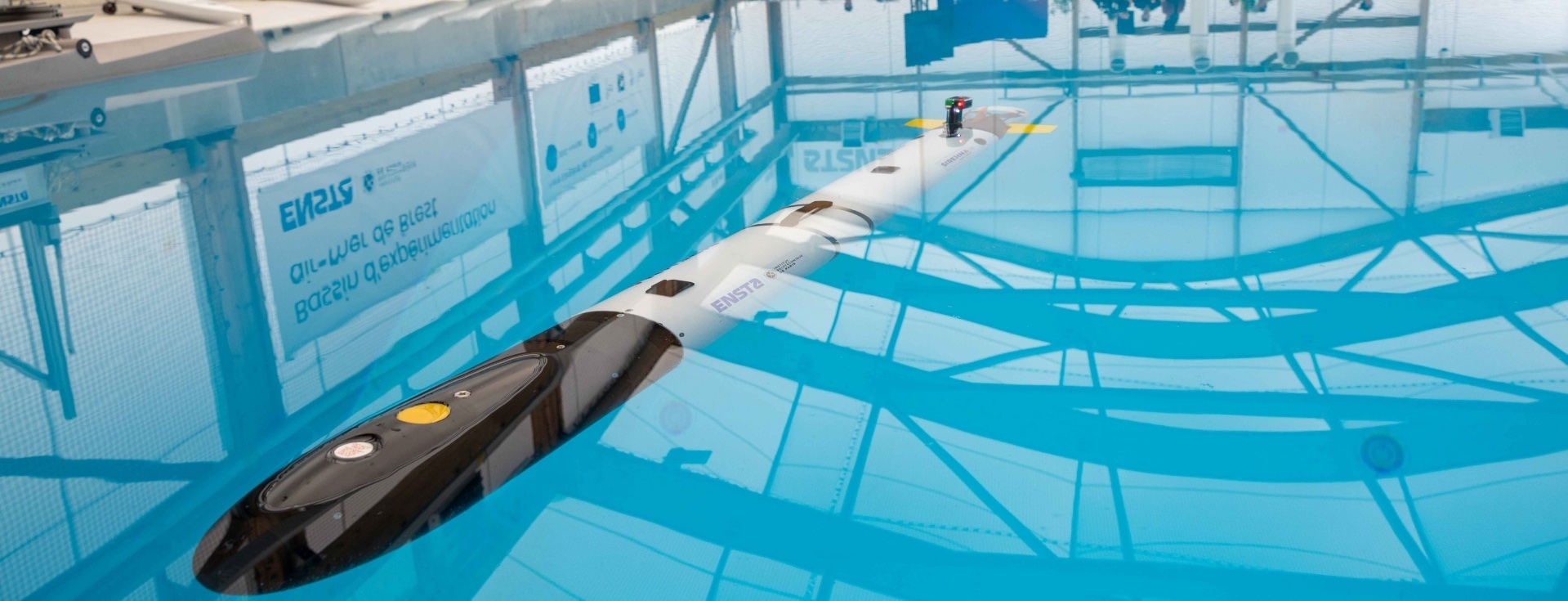
Scientists from Lab-STICC and ENSTA's S2I department, alongside the large marine science and engineering community in Brittany, now benefit from a freshwater pool measuring 20 meters long, 12 meters wide, and 6 meters deep. Its unique feature is a canvas covering that allows satellite and radio waves to pass through. This technical choice enables drones and other experimental devices to capture GPS signals inside the building. Finally, it is overlooked by a drone cage reaching up to 5 meters in height, features a movable floor, and is equipped with multiple measurement tools.
Major Scientific Projects
Thanks to this new pool, scientific teams on ENSTA’s Brest campus possess a complementary set of experimental resources at sea and on land, meeting the needs for ocean knowledge and modeling. Indeed, the facility allows for the study of new observation methods and technologies, such as multi-environment autonomous robotics and acoustic systems. Other areas related to aerial and underwater communications, as well as data processing (sensors, AI), will also be closely examined.
Several major research projects are already underway on site. These include, for example, the development of a fleet of marine robots dedicated to studying the cybersecurity of drone swarms (RACAM) and a program involving several autonomous floaters for deep-sea exploration (ID-GF). Other experiments focus on developing a new technology for underwater profilers (EMOI), a docking system for underwater refueling robots (AUVr), and a fleet of coordinated robots for manipulating heavy objects underwater (MOSTS).
The Brest air-sea testing pool thus paves the way for a multitude of applications, ranging from defense and maritime security to marine environmental monitoring, marine renewable energies, and shipping. It also covers the modeling and surveillance of the seabed and coastlines, as well as deep-sea exploration and mapping.
* Lab-STICC: a joint research unit CNRS, IMT Atlantique, ENSTA, Université de Bretagne Occidentale, Université Bretagne Sud, École Nationale d'ingénieur de Brest, Institut Polytechnique de Paris, 91120 Palaiseau, France.
.jpg)
.jpg)