



From Invention to Innovation: The Dual-Use Start-Up Plasana Medical Accelerates Wound Healing Through Cold Plasmas
Stimulating the Pillars of Wound Healing
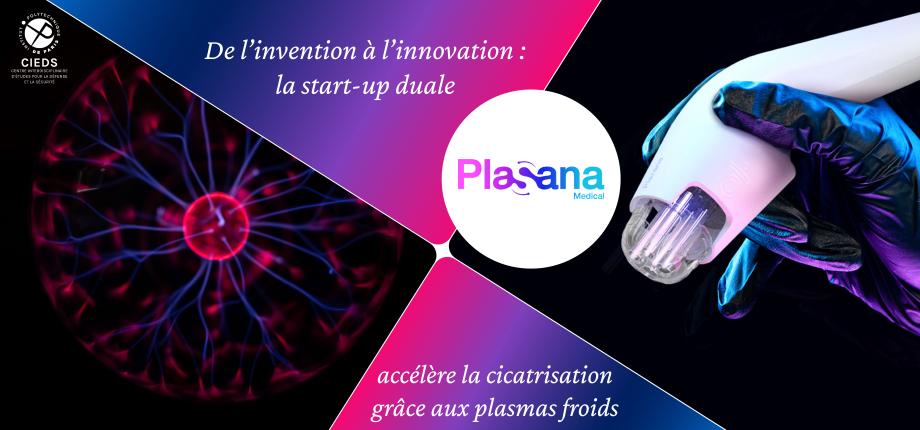
Cold plasmas are partially ionised gases in which electrons can reach temperatures of several tens of thousands of kelvin, while the positive ions and the surrounding gas remain close to room temperature. For several years, the application of cold plasmas in medicine has generated strong interest within the plasma physics community. In response to the issue of severe burns affecting the armed forces, the Directorate General of Armaments (DGA) entrusted Professor Antoine Rousseau, Research Director at the Plasma Physics Laboratory (LPP) of École polytechnique, in 2016 with the mission of developing a device to improve the healing of such burns while preventing local infections. This marked the beginning of the PlasmaSkin project.
Studies were conducted in collaboration with the French Armed Forces Biomedical Research Institute and the Institut Pasteur using in vitro (in the laboratory, outside a living organism) and in vivo (directly on a living organism) models of severe burns. The results were conclusive.
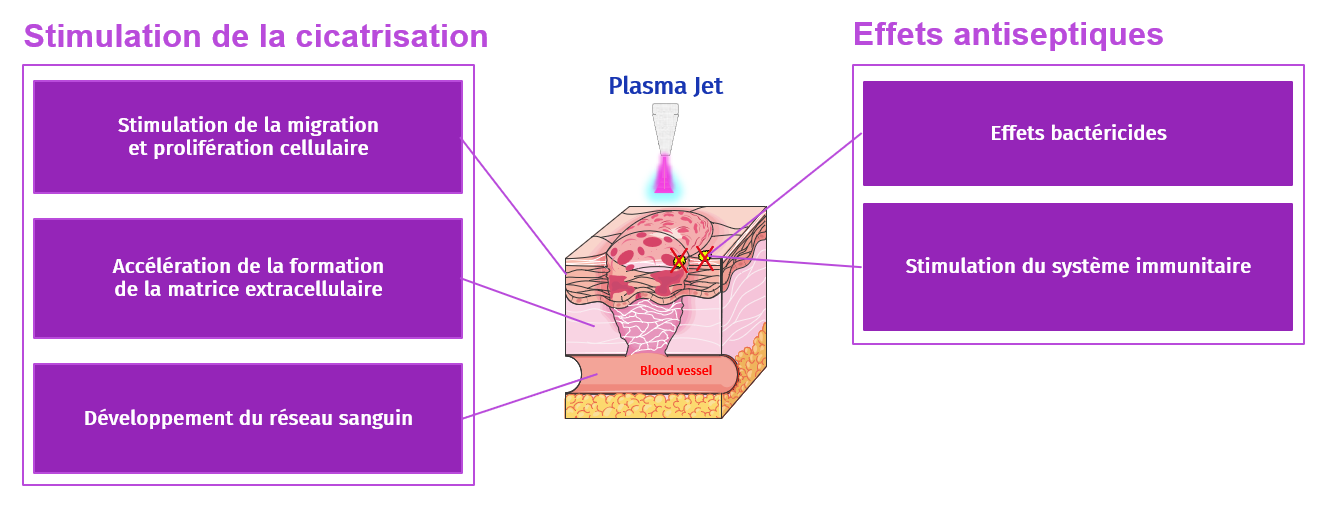
In 2017, the scientists demonstrated that, under certain conditions, cold plasmas can stimulate the four fundamental pillars of wound healing:
- The growth of cells known as keratinocytes, which make up the epidermis — in other words, the outermost layer of the skin
- The activation of cells in the dermis, such as fibroblasts, which provide skin elasticity through the production of collagen
- Vascularisation, i.e. the formation and development of blood vessels to meet the oxygen and nutrient requirements of different parts of the body
- The strengthening of immune defences, coupled with a remarkable bactericidal effect, in other words a strong capacity to kill bacteria
A Future Therapy with Dual Applications
In the case of the armed forces, the technology developed could be used to treat severe burns. However, it is not intended for use on the front line. War casualties with severe burns must first be stabilised and, in some cases, undergo grafting before they can benefit from the cold plasma wound-healing device.
To this end, the start-up Plasana Medical was founded in November 2022 by Yves Matton, an entrepreneur at the start-up studio Technofounders and a graduate of the École Polytechnique and MIT, and co-founded by Antoine Rousseau.
Plasana One, the medical device developed by Plasana Medical, consists of applying a jet of cold plasma to a wound for one to two minutes, after removal of the dressing and preparation of the wound. This device significantly accelerates wound-healing time and reduces the risk of infection thanks to the antiseptic action of the plasma. It is also quick to use, easy to handle, and requires no contact with the wound. Lightweight, it can easily be carried in a backpack, facilitating its deployment by medical teams. It could also be used to treat large and deep wounds.
Plasana One is currently undergoing clinical trials for the treatment of chronic wounds, such as venous ulcers, pressure sores and diabetic foot ulcers, with a view to obtaining CE marking for the medical device, a prerequisite for its industrialisation. Further developments will be required to enable the treatment of patients with severe burns.
The start-up Plasana Medical has also received two awards for the development of this technology:
- the Palmarès des Inventeurs 2025 Award, presented by Le Point magazine, which honours entrepreneurs whose technological advances are transforming everyday life
- the SPRING 50 Award, which recognises the five most promising start-ups on the Saclay plateau
Long-Term Interdisciplinary Research
Plasana Medical stems from more than ten years of interdisciplinary research, conducted in particular at the Plasma Physics Laboratory by Antoine Rousseau and his team.
To move from a laboratory idea or proof of concept to a medical device, long-term institutional support is essential. We were fortunate to benefit from an ecosystem as supportive as that of the Institut Polytechnique de Paris.
The Plasmaskin project, initiated by the DGA and subsequently funded by the AID, represents the genesis of these scientific studies on the use of cold plasmas to promote wound healing and prevent local infections.
From 2019 onwards, the Institut Polytechnique de Paris (IP Paris), École polytechnique and its foundation, as well as SATT Paris-Saclay joined the DGA, the Defence Innovation Agency (AID) and the Interdisciplinary Centre for Defence and Security Studies (CIEDS) to support the research projects conducted at the LPP and facilitate technology transfer.
From 2021 to 2024, the AID funded the Novoplasm project. This funding complemented the pre-maturation support from IP Paris. Novoplasm enabled the development of a prototype composed of multiple plasma jets that could be used to treat extensive burns. From 2022, the AID financed the CICAPLASMA project via CIEDS. This project aims to design and produce a prototype for the preclinical treatment of extensive skin wounds on animal models physiologically similar to humans.
More recently, Plasana Medical, now with six employees, raised four million euros in equity and non-dilutive funding. The start-up is preparing to launch its first medical product within the next two years.
This fundraising will enable us to conduct our first clinical trial in France – Plasana Genesis, currently underway – with the aim of obtaining CE marking in 2026 and initiating steps towards access to the US market.
I am very proud to see this revolutionary technology coming to market, offering new prospects for the ten million patients with chronic wounds in Europe and the United States.