



Improving medical decision-making through imaging and AI: Maxime Di Folco's research
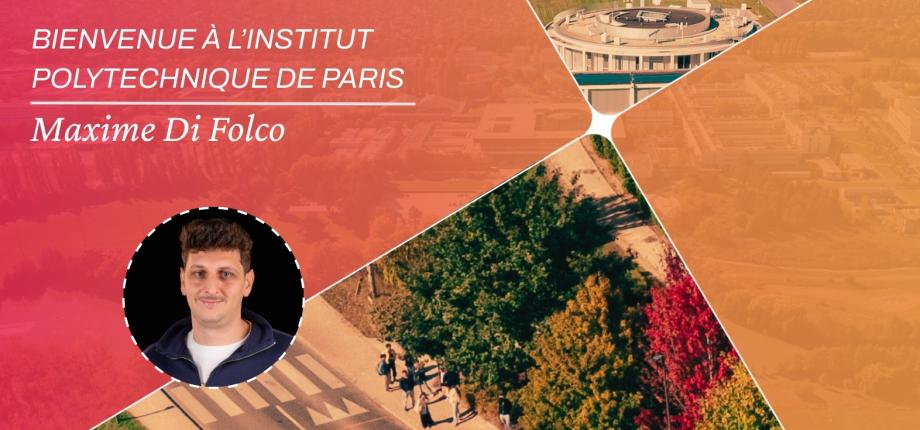
Medical imaging has been the common thread throughout Maxime Di Folco's career. It is therefore only natural that he should now be joining the Imaging team at Télécom Paris's Information Processing and Communication Laboratory (LTCI)* as a senior lecturer.
This position, supported by the interdisciplinary Engineering for Health center as part of a Tenure Track contract with the Institut Polytechnique de Paris**, is a continuation of a journey that began ten years ago at CPE Lyon. It was at this engineering school specializing in digital sciences that Maxime Di Folco became fascinated by the “Image, Modeling, and Computing” option and by the idea of using computers to code mathematics and various phenomena. He also became captivated by academic research during a gap year at the Fraunhofer IPK Institute in Berlin. “I was struck by the freedom it allowed and decided to pursue this path,” recalls the researcher. “I chose medical imaging because it made sense to me, but also because I enjoyed the interdisciplinary nature of the field and its interface with the medical world.”
He returned to Lyon for the final year of his engineering degree, in partnership with Claude Bernard University. The student completed an internship at the Center for Research in Signal Acquisition and Processing for Health (CREATIS) and entered the world of cardiac imaging. “The aim was to use MRI scans from a population of heart attack patients to statistically study the shape and location of their heart attacks.” Maxime Di Folco continued this research in the same laboratory during his PhD, studying the links between the shape of the heart at a given moment and its deformation, i.e., the evolution of its shape during a heartbeat. “The aim of my work was to statistically identify anomalies corresponding to different cardiac pathologies,” explains the scientist.
With his thesis in hand, the young researcher landed a postdoctoral contract at the Helmholtz Munich research institute (in partnership with the Technical University of Munich), where he worked on analyzing cardiac MRI data for medical decision-making. He then trained an algorithm capable of diagnosing certain diseases based on these images. “We had to consider a large number of databases, learn how to summarize the information, and represent it in such a way that it could be reused for different tasks, including diagnosis. It was a particularly stimulating challenge,” explains Maxime Di Folco.
Complex data and decision-making
For now, the applications of this work remain primarily diagnostic, but the researcher plans to introduce a temporal dimension so that he can predict the evolution of anomalies, such as myocardial scarring following a heart attack. With this in mind, Maxime Di Folco hopes to use his contract at LTCI to develop new methods combining MRI data with multimodal data (i.e., data of different types). "I am interested in tabular data, i.e., data extracted from Excel spreadsheets and health databases. This data contains a wealth of information (gender, medical history, environment, socioeconomic status, treatments, etc.) and is therefore complex to use for training current AI models. I am therefore studying how to integrate it with medical images in an optimal way. Should the algorithms be fed all the information (tabular and image data) at once, or should this be done in two stages? The methodology used will have an impact on improving decision-making," emphasizes the senior lecturer.
Maxime Di Folco is basing his work on existing algorithms, which he is adapting to medical imaging by introducing certain innovations. He also plans to study any biases that may exist in the data used to make decisions more reliable.
By joining the LTCI's Tenure Track program, the researcher will be able to apply his work to oncology, and more specifically to breast cancer. “The expertise of my colleagues is invaluable, and I am increasing my contacts with doctors in the IP Paris ecosystem to find issues that are compatible with my methodology.” He intends to make this partnership dynamic a long-term one and will have the necessary resources to recruit a doctoral student to assist him in his work.
At the same time, Maxime Di Folco will be involved in the “Imaging and image-based modeling” track of IP Paris's Master 2 Biomedical Engineering (BME) program, which is dedicated to biological and medical imaging. "The Tenure Track offers me this opportunity to teach. It's very important to me. Passing on a passion for what we do, making it accessible to a wider audience... These are activities that are particularly close to my heart."
**As part of the STEP² project selected by the ANR during the call for projects “Excellence in all its forms” (EXES) France 2030 (ANR-22-EXES-0013)
About Maxime Di Folco
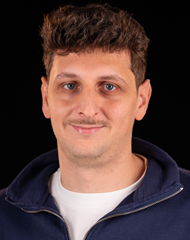
Maxime Di Folco's research focuses on the development of multimodal artificial intelligence methods for medical imaging, with particular applications in cardiovascular disease and cancer. He first specialized in learning methods applied to medical imaging during his PhD. He then deepened his expertise in artificial intelligence during his postdoctoral work, which focused on representation learning for cardiac imaging. He is now interested in different strategies for combining medical images with patient clinical data (age, medical history, biological tests, etc.).
*LTCI : a research lab Télécom Paris, Institut Polytechnique de Paris, 91120 Palaiseau, France