



Clémence Badie: a specialist in thin-film materials for water electrolysis and hydrogen production
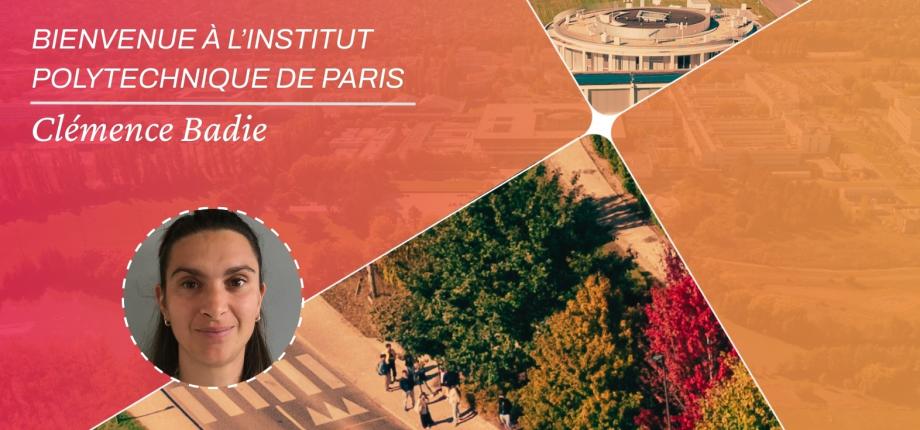
Having just arrived at the Laboratory of Condensed Matter for Physics (PMC**), Clémence Badie is an expert in Atomic Layer Deposition (ALD), a technique that involves growing a thin layer of material at the nanometric scale on a given support (the substrate) in a vacuum reactor in a controlled manner. Since her Master's 1 internship at the University of Erlangen in Germany, the young researcher has continued to hone her skills in this field. “I cut my teeth working with a postdoctoral researcher who, even back then, showed me how to perform the manipulations that I will be carrying out here at the PMC.”
Academic vocation
Clémence Badie discovered the field of academic research, where teams select and apply the techniques that will enable them to develop and characterize their samples. Within a few months, the young woman was preparing her samples on her own, observing them under an electron microscope, and testing them for electrochemical applications. Working independently and impressed by the equipment and knowledge available to her, Clémence Badie was bitten by the academic research bug. This would become her vocation, as confirmed by a more theoretical Master's 2 internship at the CNRS, which contrasted with her previous experience.
She then set out to find a thesis in which she could apply the experimental practices she had learned in Germany. The doctoral student joined the Interdisciplinary Center for Nanosciences in Marseille (CINaM – CNRS), where she contributed to an ANR project using the reactors she knew well and involving a company and a laboratory in Montpellier. “I wanted to consolidate my academic profile, so I started a postdoctoral fellowship at Eindhoven University of Technology in the Netherlands on similar ALD techniques.” There, Clémence Badie built her skill set, developed new processes, and invested herself in understanding the materials she was using. “I tested new deposition processes for new applications,” recalls the young researcher.
Understanding materials
By applying for a tenure-track lecturer position at the PMC, Clémence Badie intends to further her work and expertise in ALD. “My work will initially focus on the development of thin-film materials for water electrolysis and hydrogen production.” Water electrolysis, or “water splitting,” involves dissociating H2O molecules into hydrogen (H2) and oxygen (O2) through redox reactions. The electrochemical reactions occur at the interface between the electrode and the liquid in which it is immersed (the electrolyte). The researcher's task is to coat these electrodes with a thin layer of material that will ensure their longevity and optimize the efficiency of the electrochemical reaction. “The aim of my project is to synthesize thin layers of materials in a controlled manner on 3D substrates and then to study and understand their electrochemical properties according to the reactions in which they are involved.”
The materials obtained during this work may also have properties that are of interest for other applications or areas of research. “By enabling and promoting interdisciplinary projects, particularly within the framework of M4S, it becomes possible to expand one's knowledge base, interact with other colleagues, and collaborate. This really makes sense to me.”
Getting to the heart of the matter
The collective spirit and solidarity among colleagues became clear to the lecturer when she arrived at IP Paris. “Thin film synthesis in the gas phase is the basis of my project, but my reactor is not ready. However, I have to start my research and teaching activities. Fortunately, my colleagues are giving me access to their equipment. With the help of a labwork student, I was able to carry out layer-by-layer deposits in solution. This spirit of mutual support is really motivating.”
Clémence Badie can therefore already begin her scientific project. Thanks to the Tenure Track contract, she has access to funding and human resources (engineering skills, doctoral students, etc.) from the moment she takes up her position to build the ideal reactor for her project. “It's both an opportunity and a responsibility,” she emphasizes.
The researcher is also gradually preparing for the future teaching assignments planned under the Tenure Track program and welcomes IP Paris students to the laboratory for practical work. "It's rewarding and stimulating to be able to pass on the knowledge generated by researchers. And for students, it's much more meaningful to get hands-on experience. Perhaps this will inspire some of them to pursue a career in science. I can't wait to start teaching," concludes Clémence Badie.
*As part of the STEP² project selected by the ANR during the call for projects “Excellence in all its forms” (EXES) France 2030
About Clémence Badie
Clémence Badie's research focuses on the development of nanometric thin films using atomic layer deposition (ALD) for applications related to energy transition. She first specialized in ALD during her PhD, where she developed a hydrogen-selective membrane (2018-2022). Clémence Badie then further developed her ALD skills during her postdoctoral research, which focused on the deposition and characterization of electroactive thin films (2022-2025). She is currently studying the relationship between thin films—such as single- or multi-element nitrides—and their electrochemical properties. At the same time, Clémence Badie teaches in the chemistry department at École Polytechnique.
>> Clémence Badie on Google Scholar
**PMC: a joint research unit CNRS, École Polytechnique, Institut Polytechnique de Paris, 91120 Palaiseau, France