



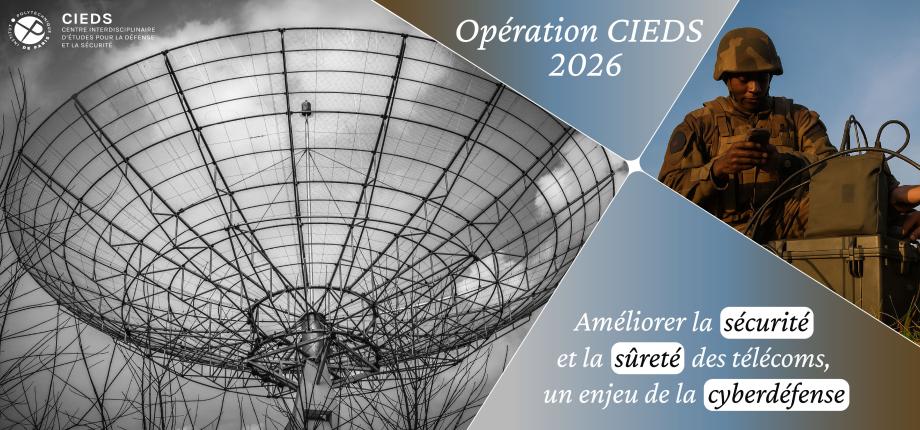
CIEDS 2026 Operation: enhancing the security and safety of telecommunications, a cyber defence issue
This is in particular the aim of research conducted by scientists such as Tarak Arbi, Clément Leroy, Melek Khemir and Emanuele Piantelli, supervised by Professor Benoît Geller, within the Computer Science and Systems Engineering Unit of ENSTA (U2IS). Among the research projects carried out, three major projects are funded by the Defence Innovation Agency as part of CIEDS.
The CODIT2 project is led from 2021 to 2025 by Benoît Geller, with the aim of strengthening traditional methods of information transmission in hostile environments, particularly those based on a technique known as spread spectrum. This technique is still used today in systems such as GPS, certain Wi-Fi and Internet of Things networks, as well as 3G. Although the civilian use of 3G and 4G cellular networks is declining sharply in favour of 5G, these networks are still used in the military domain.
In 2023, another project was launched: the SEPHYTEL project, with the objective of creating genuine protective “bubbles” around telecom signals. The results of this project, like those of CODIT2, may be applied in both the military and civilian fields. Wi-Fi standardisation committees are working on integrating spatial encryption, an approach used within this project, which makes it possible for information to be visible in only one direction and invisible in all others. In the military domain, spatial encryption could make airborne communications undetectable in their immediate environment, which represents a significant issue during military operations.
A third project, complementary to the other two, will begin in October 2026: the FORCYBEL project, with the ambition of developing a technology capable of withstanding a high level of interference while ensuring discreet transmission. FORCYBEL is aimed exclusively at the military market. The studies carried out could help improve the transmission of information in the field by protecting the signal, making it discreet, resilient to interference, and difficult to intercept.
Benoît Geller is not only a professor within the U2IS at ENSTA, he is also a reservist officer. Although these duties are not directly related to his work as a researcher, they remain fascinating and extremely rewarding, he explains. According to the scientist, the armed forces constitute a complete social organisation in which every profession has a role to play. He therefore encourages anyone wishing to step outside their daily routine and contribute to a noble cause in a spirit of camaraderie to join the reserves.