



BME Seed Grant Program: The Experience of Interdisciplinarity in Biomedical Engineering
Organized by École Polytechnique and the École Polytechnique Foundation, and supported by the Fondation Bettencourt Schueller, the Biomedical Engineering (BME) Seed Grant Program is a funding program for biomedical engineering research projects, each of which involves at least one researcher and one physician.
From its inception, the program’s goal has been to foster the development of a community of students, researchers, and physicians capable of creating a strong and sustainable momentum in France in the field of biomedical engineering through interdisciplinary collaboration.
3 calls for proposals, 11 winning projects
Specifically, between 2019 and 2022, six projects were funded at a rate of €140,000 per project over a two-year period. In 2023, during the Annual Engineering for Health Forum, five new grant recipients were selected. In addition to their governance model, which combines academic and clinical research, the selected projects are characterized by their goal of rapidly producing personalized, connected, or targeted healthcare solutions—or knowledge directly applicable to improving human health.
The Recipients of the BME Seed Grants
Watch videos about the projects 🔽
Mechanical Probing of tumor infiltrating lymphocytes
- Julien Husson, LadHyX (IP Paris)
- Emanuela Romano, Center for Cancer Immunotherapy (Institut Curie)
Multiscale characterization of myelin organization in healthy and multiple sclerotic brain tissues using third-harmonic microscopy (Brain Harmonics)
- Emmanuel Beaurepaire and Chiara Stringari LOB (IP Paris)
- Bruno Stankoff (Institut du Cerveau et de la Moelle épinière, AP-HP)
Kidney PERFusion mapping by ultrafast UltraSound Imaging for noninvasive diagnosis Of chronic Nephropathy (PERFusion)
- Jean-Luc Gennisson, IR4M (Université Paris-Saclay)
- Jean-Michel Correas, Service de Radiologie Adulte (Hôpital Necker, AP-HP)
Nuclear Caging in Vascular Endothelial Cells
- Abdul Barakat, LadHyX (IP Paris)
- Catherine Coirault, Institut de Myologie (Hôpital Pitié-Salpêtrière, AP-HP)
NAnoparticle-based ultra-Sensitive fast COVID detection Assay (NASCA)
- Cedric Bouzigues, LOB (IP Paris)
- Bruno Lina, Laboratoire Virpath (Université de Lyon), Laboratoire de Virologie (Hôpital de la Croix-Rousse, HCL)
Microfluidic Selection of Ovocytes for Assisted Reproductive Technologies (MicrOART)
- Clément Campillo, LAMBE (Université Paris-Saclay)
- Elsa Labrune, Service de médecine de la reproduction (Hôpital Femme Mère Enfant, HCL)
Targeting PDK1 kinase to calm inflammation in Amyotrophic Lateral Sclerosis: towards new therapeutic strategies
- Benoit Schneider, BIOC
- David Devos, CHU de Lille
Development of Injectable Polymer Prodrug Assemblies for the Intrauterine Treatment of Congenital Cytomegalovirus Infection
- Julien Nicolas, Université Paris Saclay
- Julien Stirnemann, Necker-Enfants Malades Maternity, AP-HP, Université Paris Cité
Impact of hemodynamics shear forces on sickle cell disease-related cerebral vasculopathy development
- Irène Vignon-Clementel, Inria
- Pablo Bartolucci, Hôpital Henri-Mondor, AP-HP
Investigation of potential biomarkers to detect chronic inflammation in Multiple Sclerosis through diffusion MRI
- Jing-Rebecca Li, ENSTA Paris et Inria, équipe Idefix
- Anne Kerbrat, CHU de Rennes
- An all-optical strategy for live imaging and manipulation of human cardioids to investigate cardiac regeneration after injury (MINIHEART)
- Willy Supatto, Ecole polytechnique (LOB)
- Virginie Lambert, Institut Mutualiste Montsouris
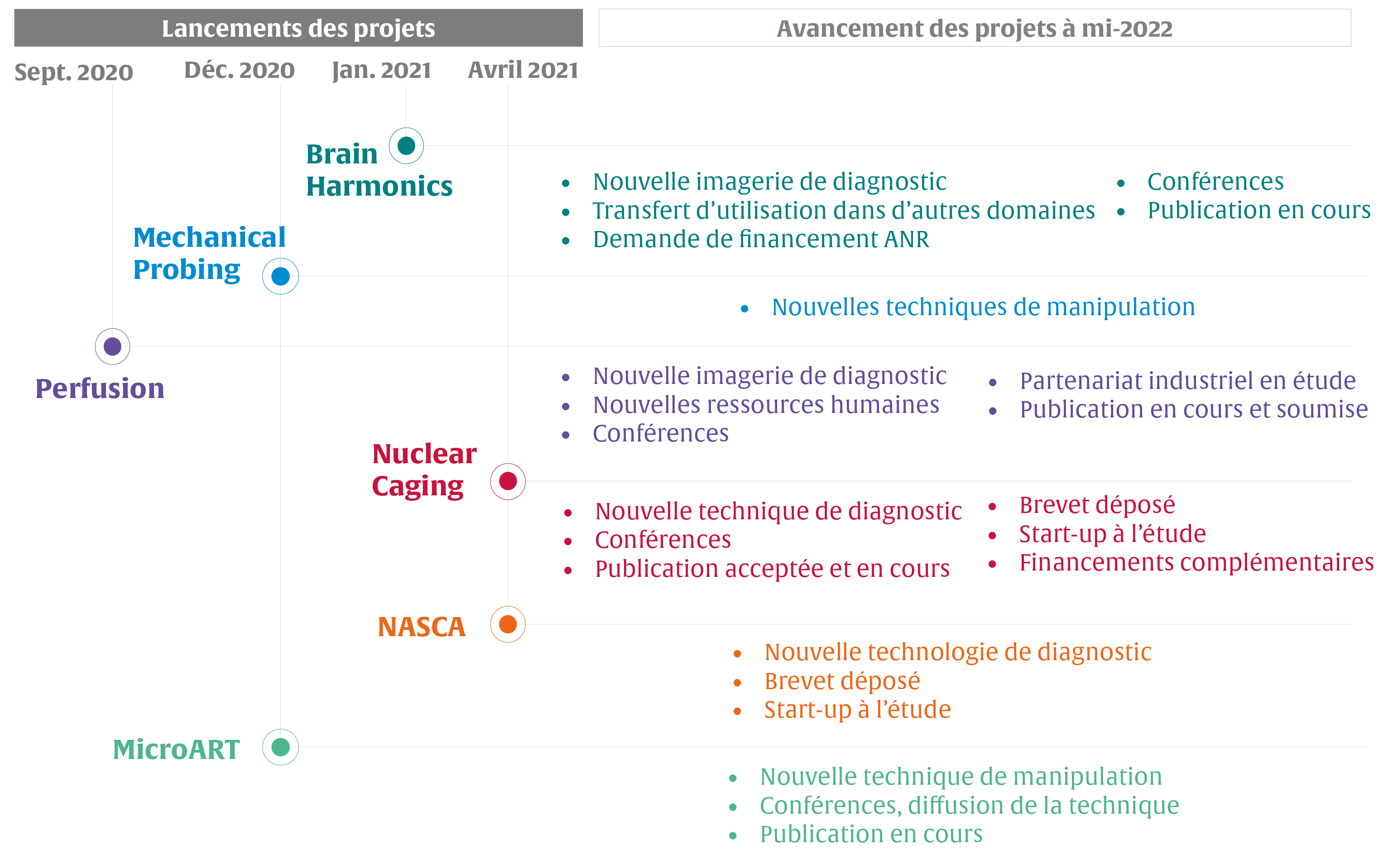
Most of the supported projects have demonstrated the feasibility of new techniques or technologies and are currently expanding the scope of their experiments. A large proportion of the teams have secured new funding to extend or expand these projects, and these innovations have already been shared with the academic and medical communities. For the projects most closely aligned with patient needs, patents have been filed or are in the process of being filed, and the creation of startups or industrial partnerships is under consideration.
Etat d’avancement des premiers projets
A simplified and tailored financing structure
In 2022, an independent survey conducted by Quadrant Conseil among the first six recipients of the BME Seed Grant Program confirmed the program’s strengths for applicants: a streamlined application process; an attractive grant amount (€140,000) and funding duration (2 years) that are well-suited for testing a project; and minimal monitoring requirements, allowing flexibility for optimal use of funds (funding a postdoctoral researcher or research engineer, and purchasing small equipment and consumables related to the research project).
A catalyst for new interdisciplinary collaborations
The BME Seed Grant Program has helped forge lasting ties between researchers and clinicians. It has reinforced medical teams’ decision to enter the field of biomedical engineering and has encouraged researchers to continue collaborating with medical teams. It has also helped stimulate interest among young researchers and engineers in an interdisciplinary approach as they move forward in their careers, whether in the public or private sector.
These results have demonstrated the need to sustain the interdisciplinary approach
As we have seen, in terms of innovation, the BME Seed Grant Program is a success. The preliminary results generated through these projects enable project leaders to apply for new funding to continue or expand their projects and, for those who wish to do so, to engage in technology transfer activities.
Another strength of the program is that, through the implementation of functional projects, it reinforces researchers’ and physicians’ commitment to the interdisciplinary field of biomedical engineering. As for the young researchers (postdoctoral fellows and/or engineers) hired for these projects, the experience of interdisciplinary work will undoubtedly influence their future choices regarding collaborations.
In light of these positive results and following a mid-term scientific and financial evaluation of the BME Seed Grant Program in June 2022, Fondation Bettencourt Schueller decided to renew its support for the program, thereby enabling the funding of the six winning projects from the 2023 call for proposals.
Beyond the program’s direct impact, the BME Seed Grant Program has quickly demonstrated the value of sustaining the interdisciplinary approach in biomedical engineering and extending it to the entire Institut Polytechnique de Paris (IP Paris).
The Creation of the Interdisciplinary Center for Engineering for Health
In July 2022, the interdisciplinary Engineering for Health (E4H) Center, whose founding members are IP Paris, Inria, and the Paris Saint-Joseph Marie Lannelongue Hospital Group, was established with the mission of adopting a highly quantitative and interdisciplinary approach to the life sciences and medicine while leveraging IP Paris’s strengths in the fields of physical sciences, mathematics, and social sciences. The BME Seed Grant Program is now an integral part of the E4H Center’s efforts to promote innovation and interdisciplinarity in biomedical engineering.
Find out more about the BME Seed Grant Program on the websites of Ecole polytechnique and Fondation Bettencourt Schueller.