



2026 French State Innovation Competitions : 7 IP Paris projects among the i-PhD and i-Lab awardees
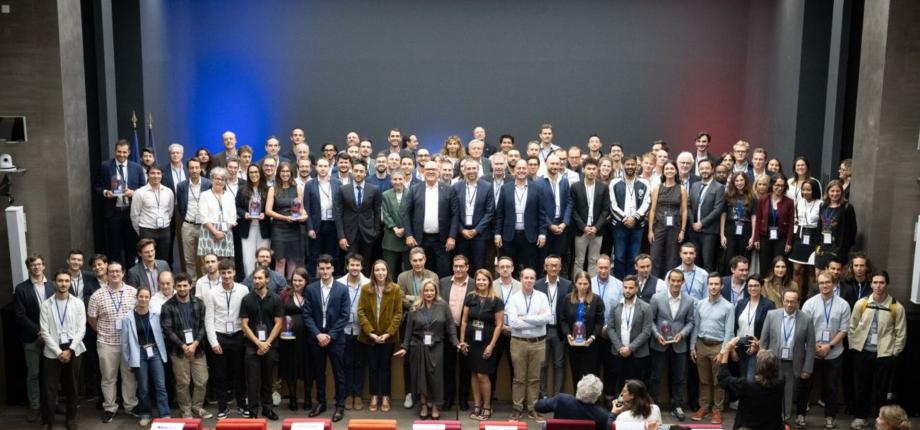
The award ceremony for the French State Innovation Competitions was held in Paris on 16 September 2026. This year, 109 projects were selected: 40 i-PhD awardees, including 10 Grand Prize winners, and 69 i-Lab awardees, including 10 Grand Prize winners. The i-Lab projects represent a total of €25 million in funding.
Funded by the French State as part of France 2030 and operated by Bpifrance, the two programmes support complementary stages of the transfer of research into business. i-PhD supports young researchers in developing the value of their research and structuring a deeptech entrepreneurial project. i-Lab, meanwhile, supports the creation and development of technology companies, notably those emerging from public research.
Three i-PhD award-winning projects, including two Grand Prizes
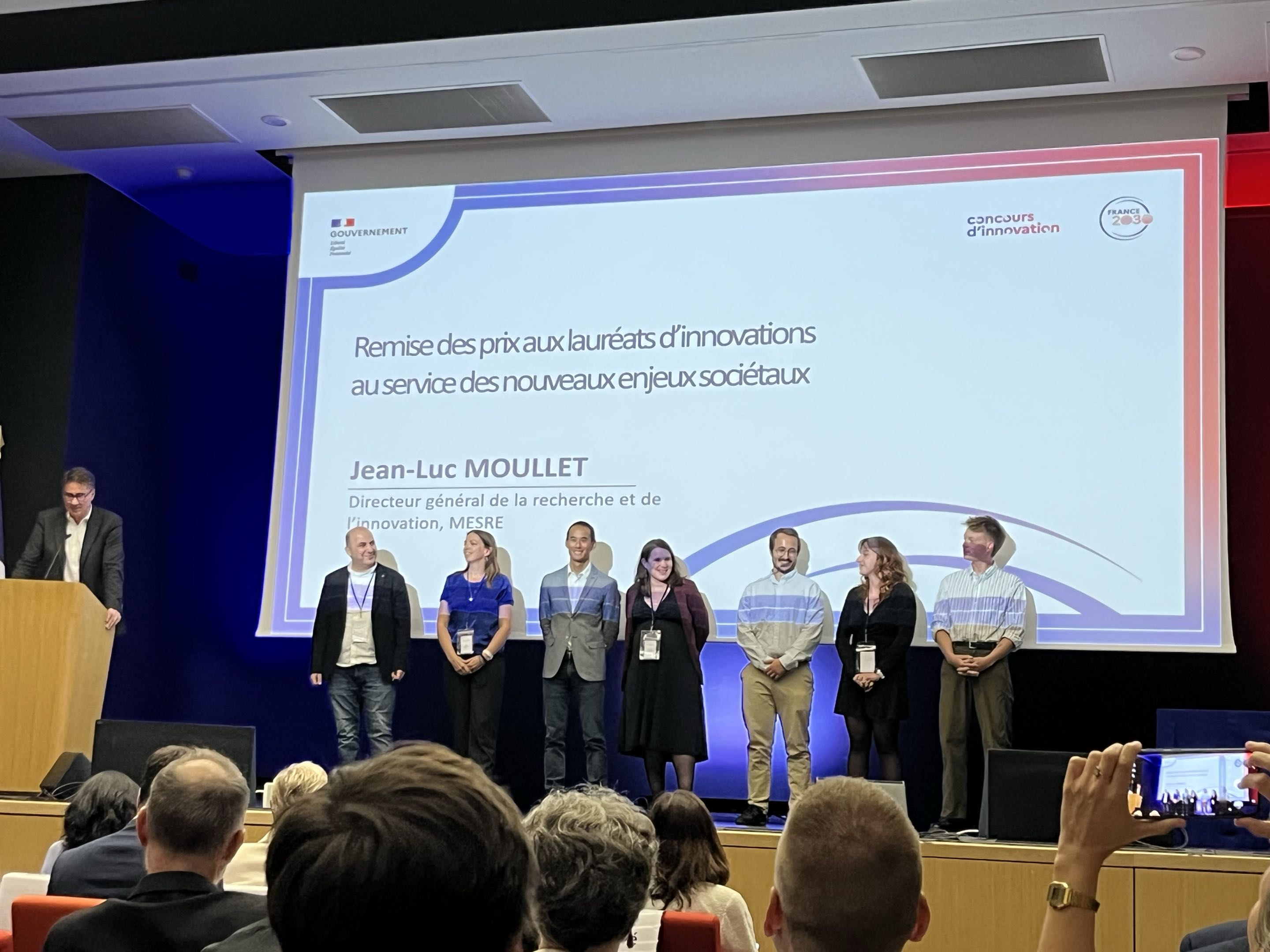
3DCAM Sensors – Gwendal Hénaff, École polytechnique – Sovereignty Grand Prize
Developed at the Plasma Physics Laboratory (LPP, CNRS, Sorbonne Université, École polytechnique, Institut Polytechnique de Paris, Palaiseau, France), 3DCAM Sensors is developing compact sensors capable of measuring charged particles in low Earth orbit in real time. The aim is to provide data that can improve the characterization of the space environment and help anticipate the risks satellites may face during solar events.
The technology stems from a PhD project co-funded by the French Space Agency (CNES) and École polytechnique, and is scheduled for an in-orbit demonstration in 2028. The project received the i-PhD Sovereignty Grand Prize.
TatouAI – Carl De Sousa Trias, Télécom SudParis – i-PhD Grand Prize
Developed at the SAMOVAR laboratory (Télécom SudParis, Institut Polytechnique de Paris, Palaiseau, France), TatouAI is developing a traceability technology for artificial intelligence models. It is designed to identify models, track their exchanges and verify their integrity throughout their distribution, storage and use.
The project therefore addresses issues related to intellectual property protection, authenticity and the governance of artificial intelligence models.
AOPOLAR - Sooyong Chae, École polytechnique
Developed at the Physics of Interfaces Laboratory (LPICM, CNRS, École polytechnique, Institut Polytechnique de Paris, Palaiseau, France), AOPOLAR is developing a technology designed to support brain tumour surgery.
The project is based on a compact, high-speed Mueller polarimeter combined with algorithms that enable real-time mapping of tumour tissue and white matter fibre bundles that need to be preserved, without the use of labelling agents.
The 40 i-PhD awardees benefit from a one-year support programme that includes coaching, meetings with entrepreneurs and immersion in the deeptech ecosystem.
Four i-Lab award-winning projects, including one Grand Prize
.jpeg)
Praedon - Maximilian Schiffer, École nationale des ponts et chaussées - i-Lab Grand Prize
A spin-off from the Research center in applied mathematics (CERMICS) and the Co-Innovation Lab at École Nationale des Ponts et Chaussées, Praedon develops AI models combining deep learning and operations research to solve decision-making problems involving significant industrial constraints.
Its “Industrial World Models” are intended for applications in transport, logistics, energy networks and industrial planning, among other fields. Praedon is one of the 10 i-Lab Grand Prize winners in 2026.
Label4.AI CROMA - Nicolas Bodin, Télécom SudParis
With CROMA, Label4.AI is developing a solution for detecting content generated or manipulated by artificial intelligence, including images, videos, voices and documents.
Installed directly on the workstation, the solution analyses different data streams locally in order to identify and characterize manipulation without transferring sensitive data to the cloud. Label4.AI is one of the startups supported by IMT Starter.
Ocean WM - Alexandre Tuel, Télécom Paris
Led by Galeio, the Ocean World Models project develops foundation models designed to analyse large volumes of data relating to marine environments, particularly satellite and acoustic data. Self-supervised learning is intended to make it possible to exploit poorly annotated or unannotated datasets and progressively combine different observation modalities.
Potential applications include sea ice and iceberg monitoring, offshore wind energy, marine pollution detection, navigation conditions and underwater acoustic analysis. Galeio is a startup from the Télécom Paris Incubator.
Sonaid.AI - Nicolas Turpault, Télécom Paris
Sonaid is developing embedded artificial intelligence capable of recognising critical sound events, such as calls for help, falls, alarms and other distress signals, directly from microphones already integrated into connected devices.
The analysis is performed locally on the device, without recording or transmitting the audio stream. The technology is aimed in particular at remote assistance services and the protection of vulnerable people. Sonaid is one of the startups supported by the Télécom Paris Incubator.
i-Lab awardees can receive financial support of up to €600,000 per project to help finalise an innovative technological product, process or service. This funding is complemented by support tailored to the development of the project and the company.