



Visit by three international researchers as part of the M4S Center's "Visiting Professors" program
As part of Institut Polytechnique de Paris' commitment to stengthening its global outlook and enhancing its international visibility, the interdisciplinary center Materials for Society (M4S) launched a call for proposals to support visits by world-class international scholars.
This past spring, three researchers were welcomed for several weeks, during which they delivered seminars, engaged in in-depth scientific discussions, and laid the groundwork for new collaborations. These visits provided valuable opportunities to stimulate scientific dialogue within the IP Paris materials community while fostering the mergence of high-impact interdisciplinary projects.
These programs are funded through the STeP² project, which was selected by the ANR in response to the "Excellence in All its formes" (EXES) France 2030 call for proposals (ANR-22-EXES-0013).
Francisco López Jiménez: when nature inspires next-generation materials
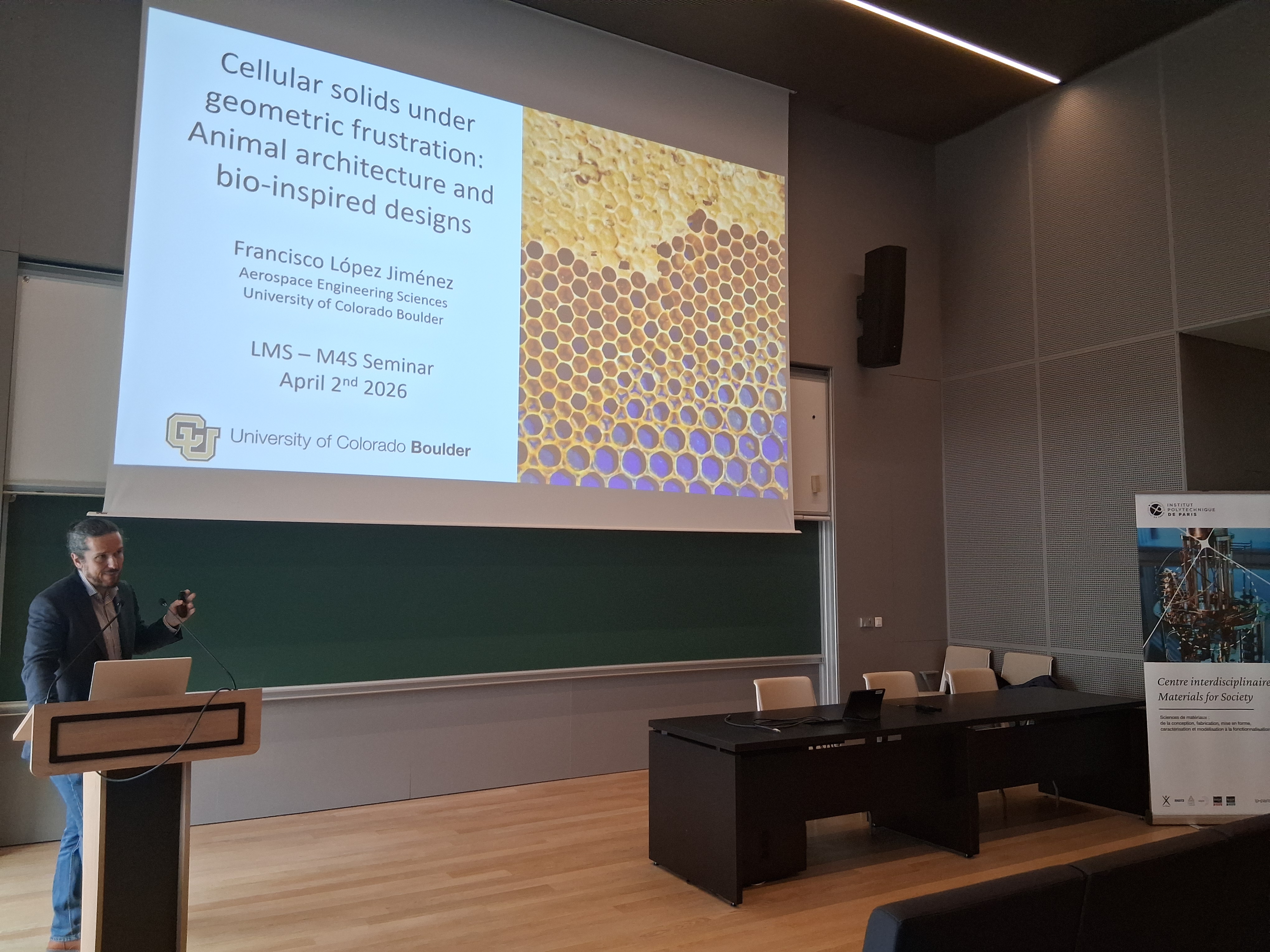
As part of this program, M4S was delighted to host Francisco López Jiménez, Associate Professor at the University of Colorado Boulder and a recognized expert in lightweight structures and composite materials. His academic trajectory - spanning the University of Sevilla, the California Institute of Technology, and postodcotral appointments at Ecole polytechnique and at Massachussetts Institute of Technology - reflects his strong ties leading international research environments.
During his stay, Francisco López Jiménez delivered a compelling talk on cellular solids under geometric constraints, drawing inspiration from a striking natural example: honeycomb architecture. Using innovative experimental setups based on 3D printing, he demonstrated how bees adapt the construction of honeycombs when faced with constraints incompatible with a regular hexagonal pattern. Sitting at the crossroads of physics, mechanics, and biology, this work opens up exciting new directions for the design of bio-inspired materials.
His research has direct implications for strategic applications, including aerospace engineering, where ultralight deployable structures are being developed, as well as ablative materials designed for extreme environments. By studying how topological defects and geometric distortions affect mechanical behaviors, he puts forward a novel design framework enabling precise control over material performance.
His visit also led to the launch of a promising collaboration with researchers at LMS, particularly on periodic and random microstructures. This interaction fully aligns with M4S's interdisciplinary approcah, bridging materials science with physics and chemistry.
Alexander Krivchikov: probing matter at extreme low temperatures
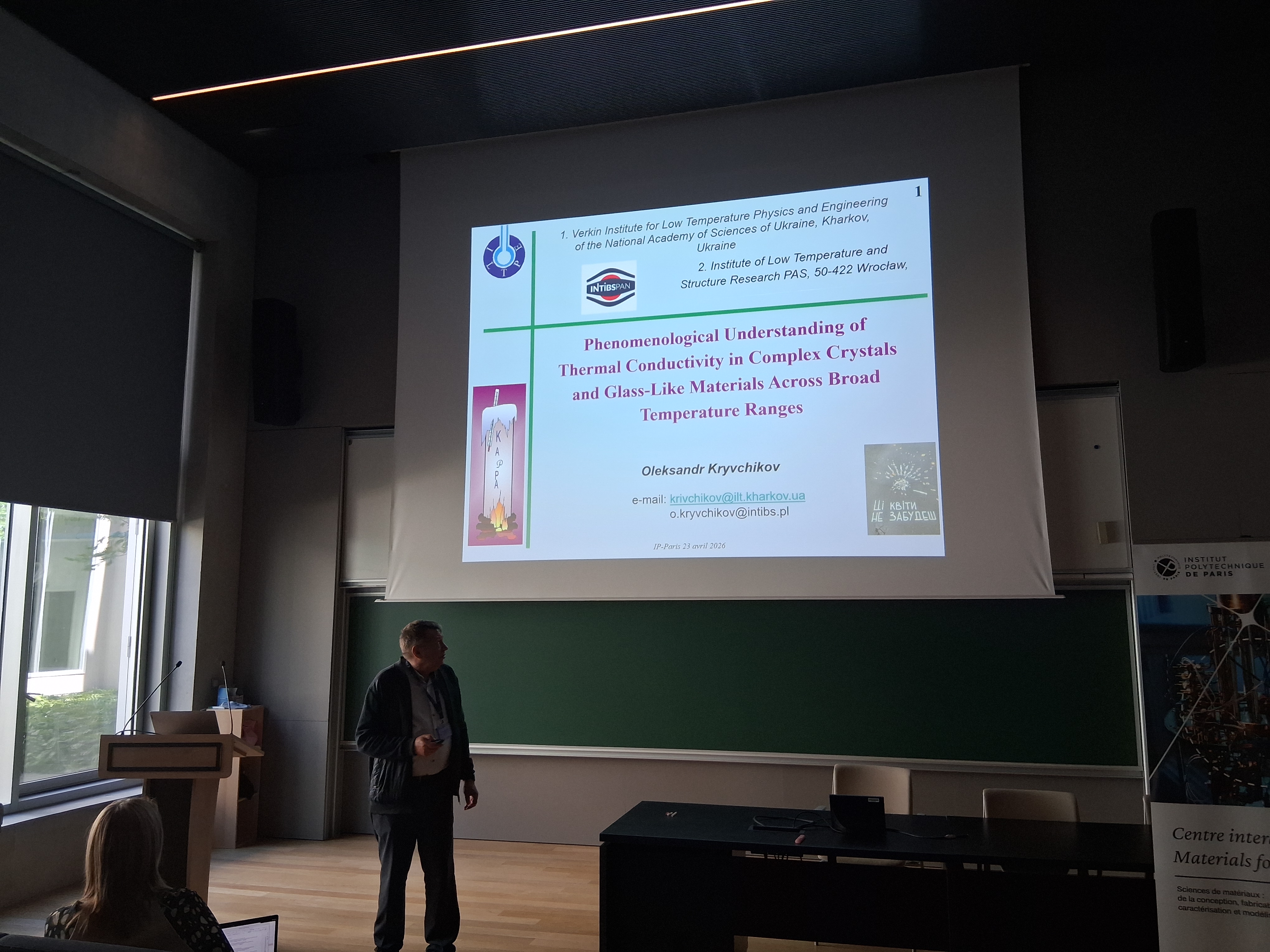
M4S also had the pleasure to welcoming Alexander Krivchikov, an internationally recognized expert in the thermal properties of solids at very low temperatures. His uniquely European carrer - spanning Ukraine, Poland, and Spain - highlights a strong track record of international collaboration.
Specializing in heat capacity measurements in the 0.4 K to 20 K range, Alexander Krivchikov investigates the fundamental mechanisms that govern heat transport in complex materials. In his lecture, he offered a comprehensive analysis of thermal conductivity in complex crystals and amorphous systems, drawing insightful parallels with so-called glass-like materials.
His experimental works sheds new light on phonon dynamics - the quasiparticles responsible for thermal energy transport in solids. Understanding their behavior in disordered or hybrid structures is a major scientific challenge, with important implications for cryogenics as well as for the design of materials with tailored thermal properties.
The rich scientific exchanges that took place during his visit have opened up new avenues for collaboration, particurlarly in the thermal characterization of advanced materials developed within M4S. These interactions are especially timely, as controlling heat transport is becoming increasingly critical in fields such as electronics, energy systems, and quantum technologies.
Beyond the immediate scientific impact, Alexander Krivchikov's visit strengthns IP Paris' ties with leading European institutions and helps position M4S as a key player in low-temperature physics.
Finally, this appointment underscores IP Paris's commitment to supporting high-level fundamental research, which is essential for the emergence of future technological innovations.
Igor Abrikosov: designing tomorrow's materials through metastable states
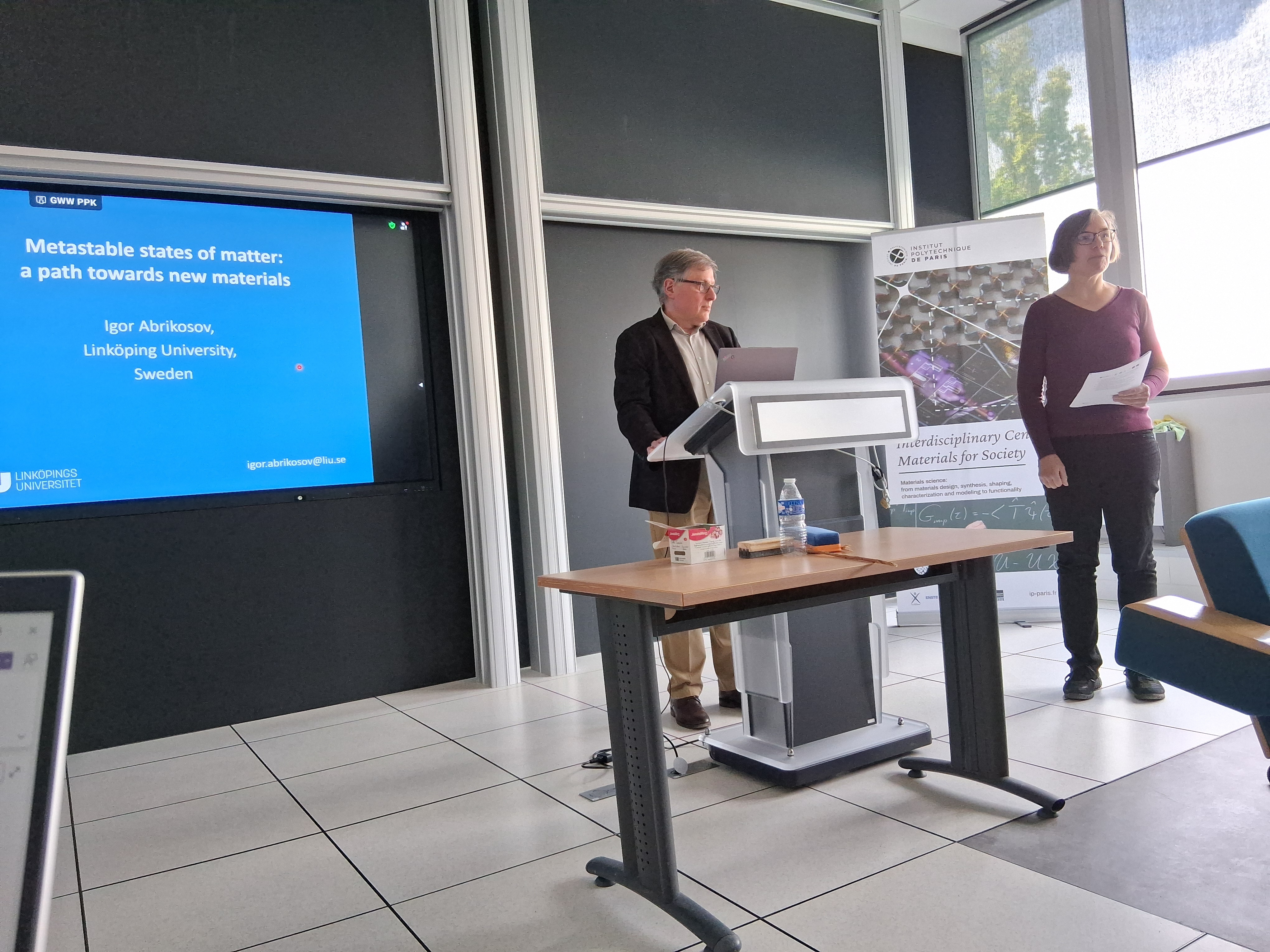
Professor Igor Abrikosov, a leading figure in theoretical materials physics, also contributed significantly to M4S's scientific momentum during his visit. His research focuses on computational approaches to deepen our fundamental understanding of materials and to accelerate the discovery of new phases with advanced functionalities.
His lecture explored an especially forward-looking theme: the use of metastable states of matter as a pathway to designing new materials. By combining theoretical modeling, extreme conditions (pressure, temperature), and experimental validation, he demonstrated how entirely new phases - inaccessible under conventional conditions - can be discovered.
Among the highlights were the prediction and realization of novel two-dimensional materials, including nitrides with remarkable electronic properties, as well as the synthesis of one-dimensional atomic chains stabilized within ionic compounds. These examples underscore the transformative role of pressure in reshaping the rules of chemistry and crystallography.
A central challenge in this field lies in preserving, at ambient conditions, the exceptional properties of materials synthesized under high pressure. Progress in this area opens up promising applications in ultra-hard materials, electronics, and energy technologies.
The collaboration initiated with IP Paris research teams - particularly in multiscale simulations and the use of machine-learning-based interatomic potentials - represents a strategic opportunity. It will help strengthen the link between theory and experiment, which is crucial to addressing today's challenges in materials science.
Igor abrikosov's visit highlights M4S's strong international appeal and its ability to operate at the forefront of materials design. It also paves the way for ambitious future collaborations and scientific breakthroughs.