



Solveig Aamlid: Decoding the Disorder in High-Entropy Oxides

Solveig Aamlid’s scientific journey began in the first half of the 2010s at the Norwegian University of Science and Technology (NTNU) in Trondheim. There, she completed a master’s degree in nanoengineering before starting her PhD in 2016. At the time, one of her professors noticed that lead-free ferroelectricity was a field yet to be cleared. He assigned her the topic (Editor's note: ferroelectric materials possess an internal polarization that can be reversed by applying an electric field). "Since ferroelectric materials are used in cutting-edge technologies, this research opened up several perspectives: a major environmental benefit, compliance with European regulations, and, from an economic standpoint, an unprecedented market opportunity," the researcher recalls with amusement.
Upon completing her thesis, the scientist flew to Vancouver, Canada, where she secured a postdoctoral contract at the University of British Columbia (UBC). She then left the world of ferroelectricity behind to transition into high-entropy oxides. "New life stages are an opportunity to change research themes. They allow you to broaden your field of expertise while reusing and improving the know-how acquired during previous experiences."
But what exactly are these high-entropy oxides that have occupied Solveig Aamlid's daily life since 2021? They are materials composed of oxygen and several chemical elements mixed in equal parts within a crystal lattice. "Generally, there should be five different chemical elements. The most well-known mixture contains magnesium, cobalt, nickel, copper, and zinc." Here, oxygen and the five metallic cations organize themselves into a regular lattice. This configuration creates a high degree of disorder at the atomic scale which, somewhat counterintuitively, stabilizes the material and endows it with singular physical properties. On a mechanical level, for instance, high-entropy oxides are harder and stronger, particularly at high temperatures, and the effects of disorder can also be useful in functional materials such as batteries, catalysis, or electronics.
Fundamental research above all
"Applications are one thing, but what interests me above all is understanding the link between atomic-scale disorder and the functionalities offered by these oxides—and by materials more broadly," the researcher emphasizes. The logic here differs from what is traditionally encountered in materials science, where properties result from adding specific elements in precise quantities. "For example, the strength of steel comes from adding carbon to the iron that composes it. Enrich the mixture with chromium, and it becomes stainless. In the case of high-entropy oxides, the level of disorder within the crystal lattice dictates their properties. It is therefore crucial to study and measure it."
Today, Solveig Aamlid's work is of a fundamental nature, leading her to study the electronic structure of crystal lattices—specifically the band gap, the energy barrier that determines electron flow in the material—as well as the vibration of their atoms (phonons). "The goal is to define a material's conductivity and understand how it dissipates heat in order to, ultimately, achieve thermoelectricity. In other words, capturing this thermal energy to generate an electric current."
Finally, the researcher is actively working on the synthesis of high-entropy oxides. The challenge is substantial! Indeed, it is not enough to simply pick elements from the Mendeleev periodic table and make them interact, as they do not all distribute uniformly within the crystal lattice, resulting in phase separation phenomena and impurities.
Computational prediction
"High-entropy oxides are therefore rarer than expected. This is why I rely on computational prediction—meaning computer processing power—to test and determine the optimal combinations of elements that allow for their synthesis and stability," Solveig Aamlid explains. The introduction of machine learning could well be the next step in her work. "Implementing AI will certainly be a real asset for sorting through and refining the millions of possibilities that arise, especially when it comes to assigning specific properties to these materials."
Thanks to her position as a Tenure-Track Assistant Professor at the PMC, Solveig Aamlid now has the material and human environment necessary to advance her research. "Since my arrival less than six months ago, we have already tested the synthesis of high-entropy oxides using a laser alongside colleagues from the laboratory, and the results are quite promising," the researcher enthuses. This is an enthusiasm she will be able to share with students of École Polytechnique's Bachelor of Science program during introductory laboratory physics sessions starting in the fall of 2026.
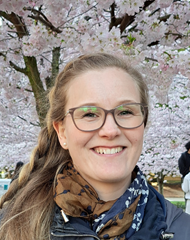
About Solveig Aamlid
Solveig Aamlid is a Tenure Track Assistant Professor at IP Paris, member of the Laboratory of Condensed Matter for Physics at École Polytechnique (PMC). She completed her PhD at the Norwegian University of Science and Technology and her postdoctoral work at the University of British Columbia. Her scientific work concerns disordered materials such as high entropy oxides, specifically on the computational prediction of the thermodynamic stability as well as the synthesis and structural characterization of these new phases.
*PMC : a joint research unit CNRS, École Polytechnique, Institut Polytechnique de Paris, 91120 Palaiseau, France
**As part of the STEP² project selected by the French National Research Agency (ANR) under the “Excellence in All Its Forms” (EXES) call for projects within the France 2030 program (ANR-22-EXES-0013).