



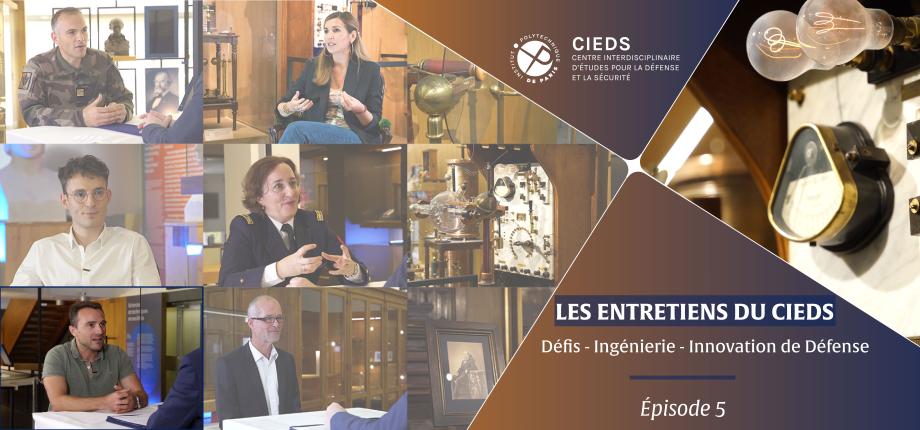
Les entretiens du CIEDS, episode 5 : Raphaël Danino-Perraud, Associate research fellow at IRSEM
About the speaker
.jpg)
Raphaël Danino-Perraud
Associate Research Fellow
IRSEM
“Innovation is not solely technical: it is also social, societal, political, economic and reflective. It is everywhere and requires us to take a step back.”
A graduate of Sciences Po Lyon in International Relations and holding a PhD in Resource Economics, Raphaël Danino-Perraud is currently a commissioned officer within the Operational Energy Service at the French Joint defense staff. He appears in this podcast in his capacity as a PhD in Economics and as an Associate Research Fellow at IRSEM. His area of expertise notably includes value chains and analyses of cobalt flows in Europe and, more broadly, worldwide. He will soon collaborate with CIEDS as part of the Chair “Life Cycle of Strategic Materials and Metals”.
Key moments of the episode
The Institute for Strategic Research of the École militaire (IRSEM) is part of the ACADEM, a network overseen by the Directorate General for International Relations and Strategy (DGRIS), which brings together all the strategic research activities of the French Ministry of Defence and Veterans Affairs. The activities of IRSEM are organised into several geographical and thematic pillars. Raphaël Danino-Perraud contributes as an Associate Research Fellow within the “Armament and Cross-cutting” domain, where issues related to energy, materials, the environment, climate, and the defence industry are addressed in a cross-cutting manner.
Production, refining and uses of cobalt
Global cobalt production currently comes 70% from the Democratic Republic of the Congo, explains Raphaël Danino-Perraud. China has invested heavily there over the past twenty years and now controls around 80% of Congolese production, he adds. The ores are then exported and refined in China, accounting for approximately 65%. The use of cobalt is dual: mobile phone batteries each contain between one and three grams of this metal, while in the aeronautics sector it is used in superalloys, particularly for the production of aircraft engines.
Strategic metals vs critical metals
A strategic raw material refers to a resource that is essential to a country’s various economic sectors, regardless of the risks involved. A critical metal, by contrast, is a metal whose supply chain is under threat and for which any restriction would have a negative impact on the economy. The guest notes that there are five key criteria used to define the criticality or strategic nature of a metal: its economic importance for a key sector, a high risk of supply disruption, the absence of effective substitutes, a lack of market transparency, and, at times, complex geology.
Metals and geopolitical conflicts
It was at the beginning of the 20th century that the issue of metals became a genuine defence concern. The emergence of large battleships, which were particularly resource-intensive in metals and relied on new and highly specific alloys, marked a revolution in military affairs.
Metal consumption then increased during the First World War, to the point that some countries faced shortages of metals such as copper by the end of the conflict. It was at this time that the concepts of critical and strategic metals emerged.
Later, during the Second World War, Germany saw its stocks of strategic metals such as germanium and tungsten—used respectively in optical instruments, and for munitions and armour—run out, which played an important role in its defeat.
During the Cold War, Western countries developed strategies to find alternatives to strategic and critical metals produced by Russia, a major player in this field.
Between 2008 and 2010, a rare earth crisis—a group of sixteen metals with shared chemical and physical properties, and considered strategic or critical—broke out. It is linked to the conflict over the Senkaku Islands.
Defence innovation priorities for metals
According to today’s guest, there are two types of innovation in the case of metals: technical innovation and political-organisational innovation. To reduce their dependence and vulnerabilities, European states are pursuing three solutions: diversifying metal supply chains, recycling, and investing in industrial capacity.
The researcher notes that over the past fifteen years, relatively little investment has been made in industrial capacity. Supply sources have indeed been diversified, but in the face of, for example, two monopolistic producers such as Russia and China, states continue to oscillate between these two suppliers. Recycling, he explains, is not a sufficient response: it is not always easy to recycle metals, and it requires significant financial and energy investment, which is not always economically viable.
According to Raphaël Danino-Perraud, it is also essential to develop financial, political and organisational solutions in the industrial sector.
The energy transition and copper
As copper is the most conductive metal, it is expected to play a key role in the energy transition. However, like all other metals, its use requires significant amounts of energy and water. Its environmental impact is therefore not negligible, the scientist notes. The energy transition as currently envisaged is framed within a perspective of unlimited economic growth; yet, in physical terms, the world is finite. The quantity of copper available on the market may not be sufficient over the next 15 to 20 years to support all energy transition programmes, the speaker warns.
The guest’s expectations of young people
The Russian invasion of Ukraine in February 2022 marked a turning point in history, and the coming years are likely to be difficult, argues Raphaël Danino-Perraud. He adds that it will most likely be necessary to reorganise socially, sociologically, societally and politically. At all these levels, he is convinced that younger generations, particularly students at the Institut Polytechnique de Paris, have a role to play and will be key actors in shaping this future organisation, which should help improve the current global situation.
The CIEDS sincerely thanks Raphaël Danino-Perraud for this insightful interview and for the time he dedicated to this brand-new initiative aimed at raising awareness of defence-related issues.