



At IP Paris, Jeffrey Harris simulates breaking waves to improve the safety of offshore structures
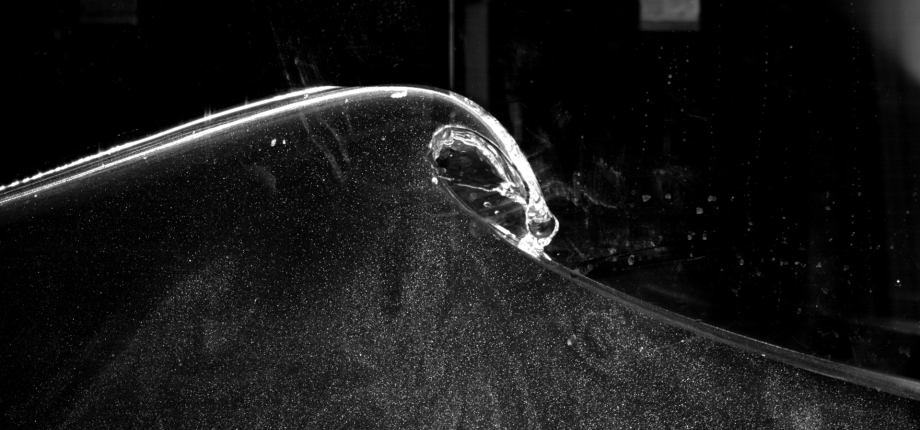
At sea, structures such as floating wind turbines are regularly subjected to wave forces. Among these “free surface waves,” as researchers call them, breaking waves have a very strong but short-lived impact that can cause submersion or intense vibrations in these structures. Jeffrey Harris develops tools to closely study breaking waves and the mechanical stresses associated with them.
The researcher has taken part in the DIMPACT and DIMPACT+ projects, led by France Energies Marines. The aim of these initiatives is to study the complex physics of these waves and the forces they transmit, in order to make offshore wind energy more reliable and less costly.
Jeffrey Harris’s work consists of modeling waves and simulating them numerically. “We aim to understand how the wave forms, propagates toward the structure, and impacts it. One of the questions we try to answer is: what determines the power of a wave?” explains the scientist.
Numerical waves: simplicity and precision
While some researchers use wave flumes to reproduce sea phenomena in the laboratory, Jeffrey Harris specializes in their numerical counterpart: numerical wave tanks. “The first ones appeared in the 1970s and 1980s. They make it possible to measure several physical quantities and vary many parameters on demand at any point in the wave. This is a major advantage over traditional wave flumes, which are often more expensive and harder to instrument.”
Thanks to these tools, Jeffrey Harris can accurately detect and model wave breaking while limiting the number of computations required. “We aim to create simplified models that do not require resource-intensive supercomputers. We select relevant values that allow us to precisely simulate the impact of a wave on a structure.”
This work has also made it possible to isolate key parameters, such as the ratio between fluid velocity (water) and wave velocity. “Beyond a certain threshold, there is a high probability that the wave will break. This is a point of great interest to both the scientific community and industry,” the researcher notes.
At the same time, other research focuses on incorporating into the models the dissipation of energy carried by breaking waves. The goal is to move beyond standard approximations that do not account for this phenomenon. “When a wave breaks, energy dissipation through turbulence, flows, foam, and trapped air at the surface is systematic. It affects offshore structures, so it is important to determine it accurately in order to better optimize their design,” adds Jeffrey Harris.
New standards for industry
The work of the researcher and his partners opens new perspectives for the maritime industry. “It contributes to a set of standards that are now more realistic and precise, allowing manufacturers of offshore structures to better control their production costs.”
This new framework helps evolve standards that now take into account extreme phenomena such as slamming (i.e., the violent impact of a moving mass of water on a surface) and its intense pressure peaks. Engineers can then rely on new technical recommendations, new calculation rules, and new safety margins.

About Jeffrey Harris
Jeffrey Harris is a researcher at the École nationale des ponts et chaussées (ENPC) within the Saint-Venant Hydraulics Laboratory. A specialist in marine hydrodynamics, his research focuses on the high-fidelity numerical modeling of breaking waves and their impacts on offshore structures, with a strong application to marine renewable energies (such as floating offshore wind). Originally from the United States, he studied ocean engineering at the University of Rhode Island, where he earned his Ph.D. in 2011. He arrived in France in 2012 for a postdoctoral fellowship at ENPC, the institution where he has since built his research career. He also holds a French Habilitation to Direct Research (HDR), which he obtained in 2017.
>> Jeffrey Harris on Google Scholar
>> Jeffrey Harris's page on the LHSV website
*LHSV : a joint research lab of École nationale des ponts et chaussées and EDF R&D